Long-distance board gaming

Over the past couple of months we’ve been trying to find fun ways to spend time with friends while we can’t see each other in person. One of the silver linings of the restrictions we’ve all been facing is that we’ve been spending more time (virtually) with friends who live abroad – a year ago, we wouldn’t really have thought of playing a board game with a friend in Spain, or playing a digital board game with a group of friends in the UK, New Zealand and Switzerland.

Here are some of the new (to us at least!) long-distance board gaming solutions we’ve found.

1. Playing a hard-copy board game via video

How does it work?

With some imagination and creativity… It works best with trivia games, as you don’t need to share the same board, so it’s not too fiddly. Two friends who are isolating together successfully linked me into a game of Cluedo using Skype – the trickiest part was showing me my cards without accidentally peeking themselves and angling the smartphone over the board so that I could plan my next move, but overall it was a huge success!  They rolled the dice for me, moved my pawn as directed and we revealed our cards to one another via video when needed.

Why it works well

In these locked down times, anything that can recreate a relaxed evening hanging out at a friend’s house is a success, and this is a great way of achieving that.

2. Playing digital board games online

How does it work?

Several online platforms recreate digital versions of board games that you can play remotely with your friends. Tabletop Simulator, which is available on Steam, enables you to download ‘virtual’ board games which operate in the physics provided by the simulator. Another option is the Board Game Arena website, which lets you play a number of digital board games for free, although popular games such as Carcassonne require a premium account.
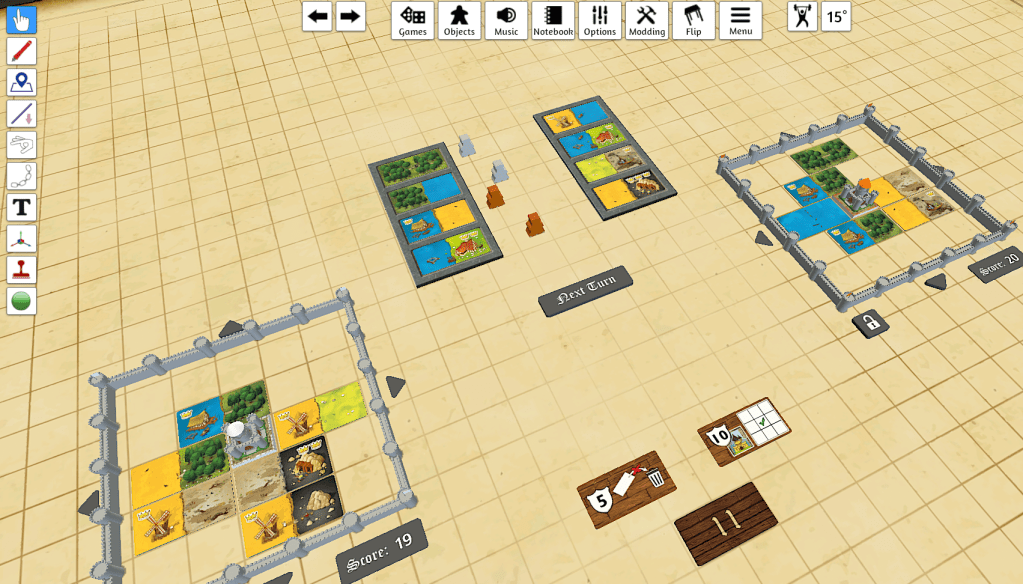
A two-player game of Kingdomino in Tabletop Simulator, complete with the infamous ‘table flip’ button at the top of the screen, for those times when it all just gets too much.

Why it works well

The platforms do a great job of recreating board games, meaning that you can still play old favourites or even try out new games while you’re separated from your friends. Tabletop Simulator has a huge range of games, both classics and new titles, as anyone can create and import them. However, this means that the usability also varies, and controlling the pieces in the virtual tabletop can take some getting used to depending on how complex the game is. Online platforms such as Board Game Arena can be slightly more user friendly and less fiddly than the simulator – it feels more like a digital copy of the board game.

3. Doing a virtual escape room
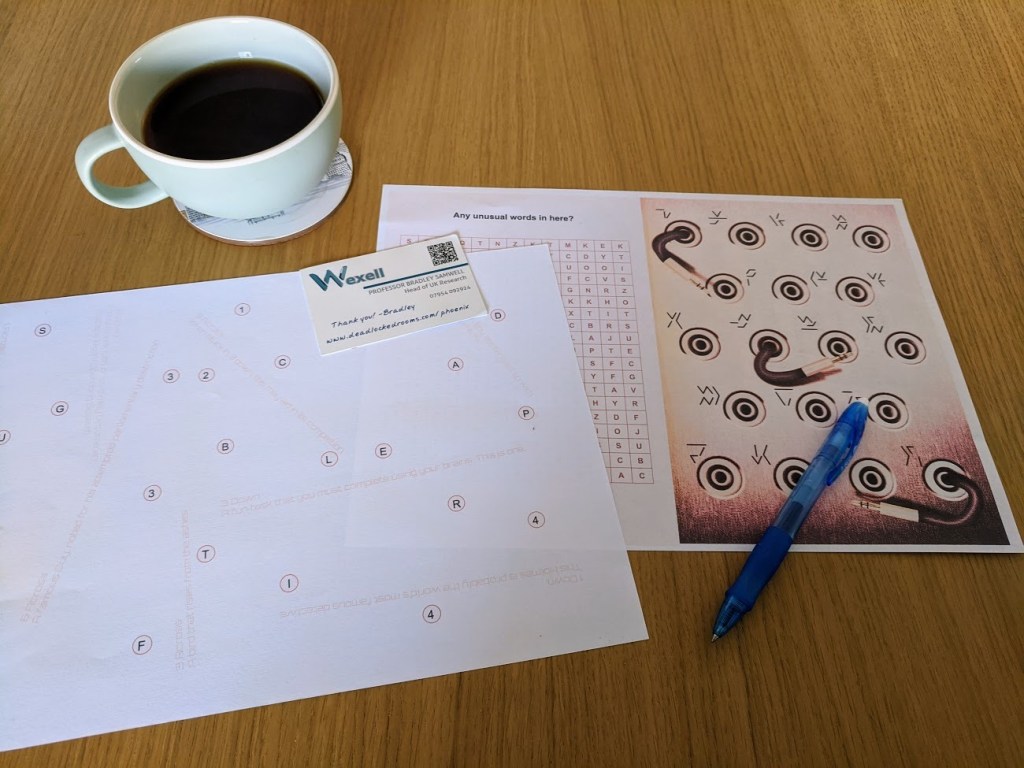
Some of the puzzles from The Insiders, Deadlocked Escape Room’s ‘escape from home’ edition. We’ve yet to complete our escape, if you haven’t heard from us in three days, send help…

How does it work?

We came across an online escape room dreamt up by Deadlocked Escape Rooms, which we have previously visited in Reading. The experience is available for a £9.99 voucher, which can be redeemed once the escape room is reopened. You work your way through the storyline by solving clues and puzzles, and you can play alone or with friends remotely via videochat – there’s no time limit, so you can take it at your own pace.

Why it works well

Although we’re still slowly making our way through the first of three chapters (we’re not escape room pros!), we’re really enjoying the puzzles and storyline. So far, we’ve hunted for clues in emails, websites and puzzles – the team have created an immersive world. It’s a fun way to spend time with friends and we’ve found it less screen-heavy and prescriptive than online board games. Plus, it supports a small business that has had to close its doors for the time being – it’s a win-win!
Carcassonne

2–5 players and 40 mins.

Come and explore the southern French city of Carcassonne, where a charming map of a medieval world is revealed with each tile laid.

How do you win?

Claim land, roads, castles or monasteries by placing your followers on the newly laid tiles to collect the most points by the end of the game.

How do you play?

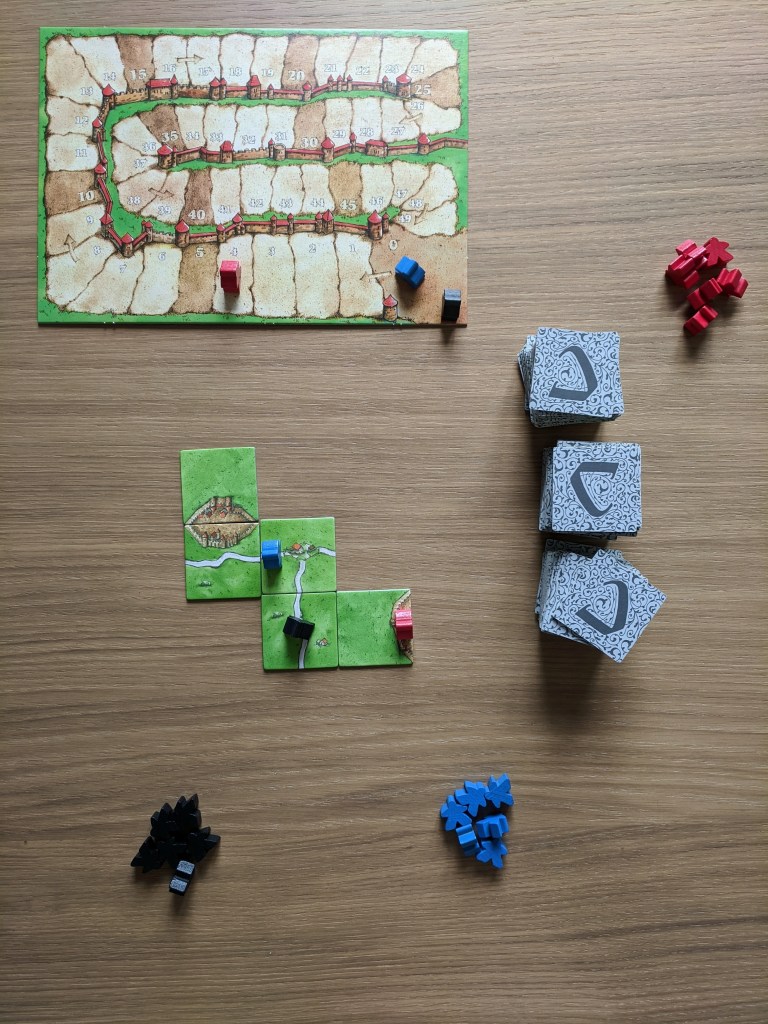
Each player collects 8 followers of their chosen colour, placing one of them on the scoring track. Place the special starting tile face-up at the centre of the table and shuffle the rest of the tiles into a facedown stack.

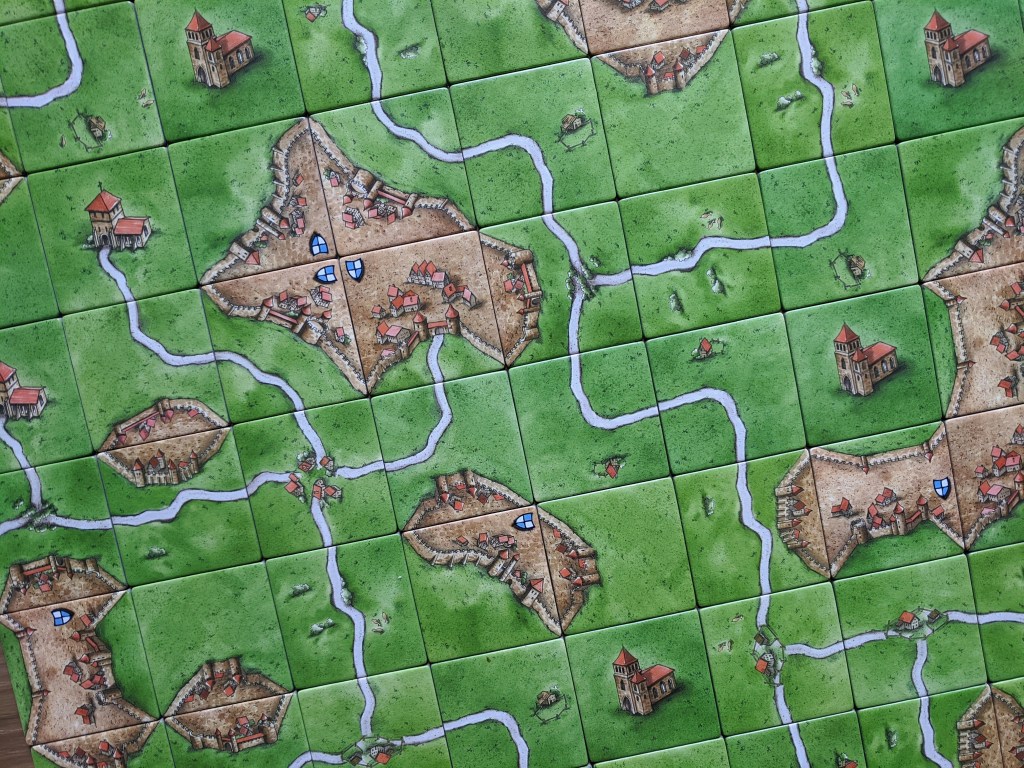
On a player’s turn, they take a tile from the stack and connect it to an existing feature on the map. Each tile will contain some combination of the four features – road, city, green fields or a monastery – and when placed, the tile must not clash with any adjacent tiles; a road on one tile cannot suddenly turn into a field on an adjacent tile, for example. Once a player has placed a tile, they may then decide whether they would like to place a follower on an unclaimed feature of that tile in order to claim points.

Four turns into a 3-player game with the scoring track at the top. The red player has already scored 4 points by completing the small city at the top left of the map and claimed a new city at the bottom right, while Blue and Black have each claimed a road.

A road is worth 1 point for each tile it runs across, an uncompleted city (where the walls do not enclose the city) is also worth 1 point per tile and a completed city is worth 2 points per tile. A monastery is worth 1 point and an additional point per tile that surrounds it (up to 9 when complete). Your follower will return to your hand for reuse once any of these features are completed.

Farms are the last type of feature and involve a longer game plan. You place a follower on an unclaimed green field and score 3 points per completed city that the field connects to at the end of the game. This can be a gamble as it leaves you with one less follower to play for the remainder of the game but may yield a large bounty of points to add to your score when the game is complete.

Once a player has placed a tile and decided whether or not to place a follower, then their turn is over and play moves clockwise. Play continues until all tiles have been placed and the whole map is revealed.

Why play it?

Although the rules are simple, competition can be intense. Players may scupper your plans for a large city of your own with one strategically placed tile, or place the exact tile you had been waiting for in the middle of nowhere! The clever tile mechanic also means a new layout is created every time you play. As each neatly illustrated tile is placed, it reveals a small medieval world that you could imagine yourself exploring.

Can you spot the same five tiles in the middle? This is the same game as the image above, but the map has grown! Note the three monasteries on the map, one claimed by Blue and another Black.

There is a tense moment each time you reveal the next tile to lay, hoping that you will pick the perfect square to complete your city – only for you to reveal yet another piece of road! Perhaps next time…

You will attempt to convince others to lay tiles at locations that benefit you, perhaps to complete a city or fill up land adjacent to one of your monasteries, but an opponent usually only helps if there is something in it for them.

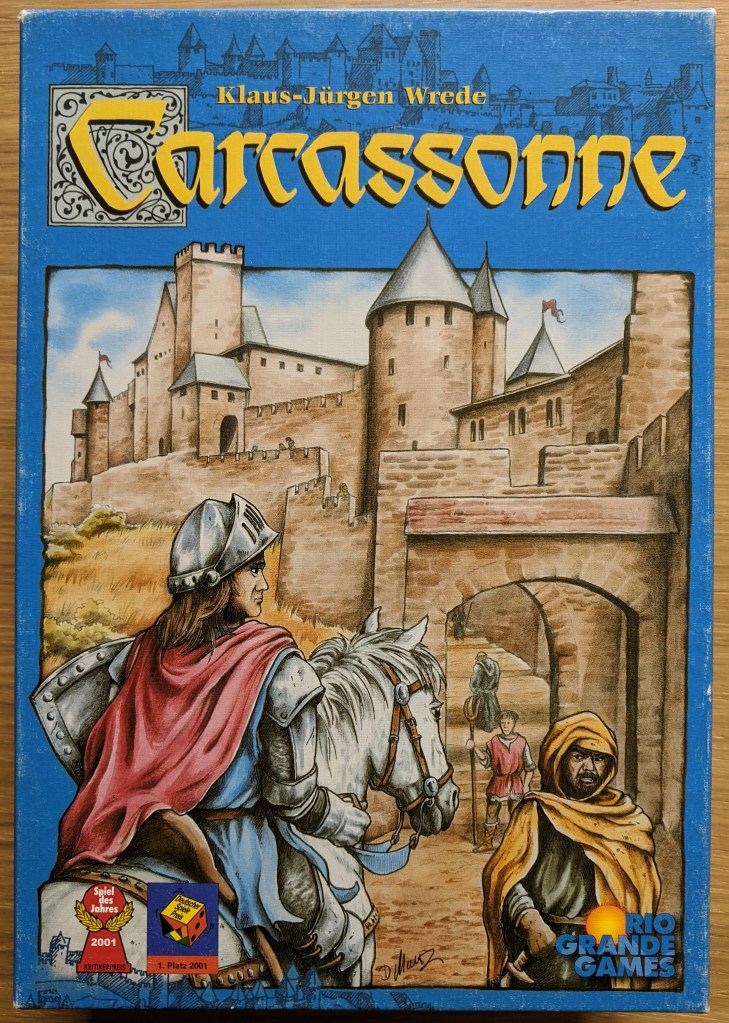
An older copy of original Carcassonne. You can find a whole host of expansions and editions of this highly successful boardgame.

Sometimes cities or farms can grow so large that two separate areas merge, meaning that two players have a follower laying claim to the same area. Should this be the case when scored, then both players would claim the points. However, you will want to watch out for opponents trying to overwhelm you in a city or farm by strategically placing a larger number of their followers on new tiles, which they will then attempt to connect to an existing area in order to exclude you and claim all the points for themselves! This is especially true for large farms, which can snake around most of the map by the end of the game, yielding a large number of points to whomever controls them.

Verdict?

Carcassonne is a cheerful yet competitive little game that works well with any number of players – even two! The rules are simple and building up the map is very pleasing.

Cartagena

2–5 players and 40 mins.

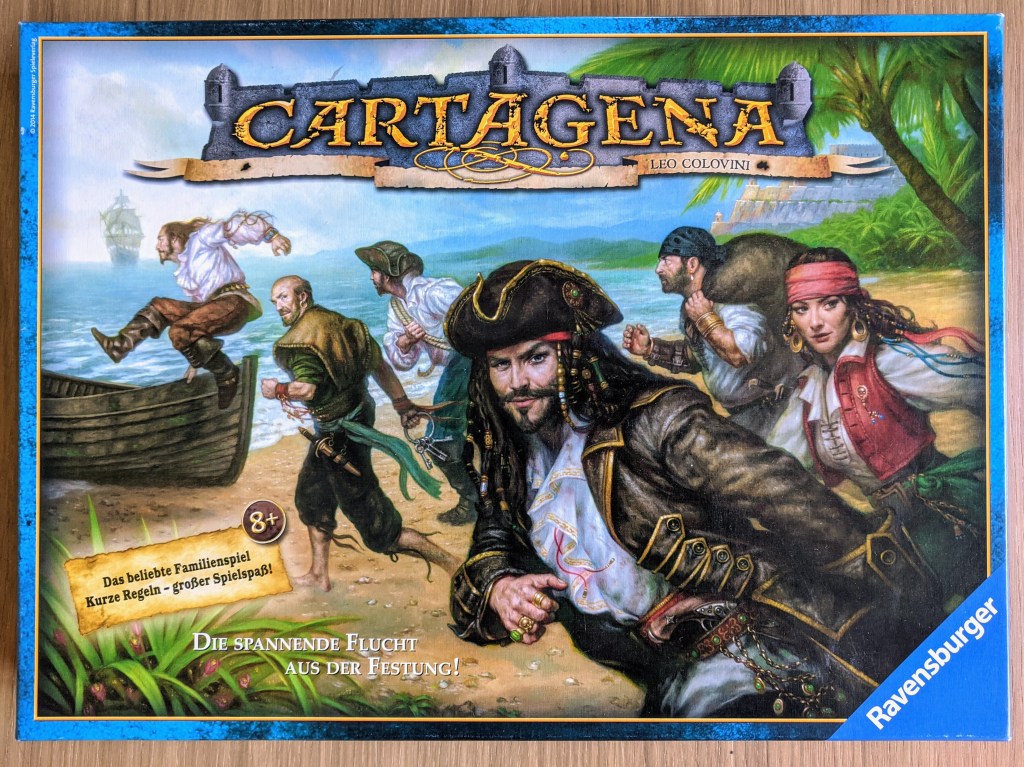
Pirates are scattering from the Fortress of Cartagena and it’s every man for himself during the jailbreak. Get to the boat using whatever tools you can gather and freedom is yours!

How do you win?

Get all of the pirates of your colour on board the boat moored at the end of the escape trail.

How do you play?

Set up the escape route that leads from the meeting place to the boat by laying the colourful path tiles – these are double sided and can be placed in a variety of ways, making the game a little different each time you play.  

Each player then places their five pirates at the meeting place and is dealt five item cards. The first player picks up one extra card so that they hold six items in their hand.

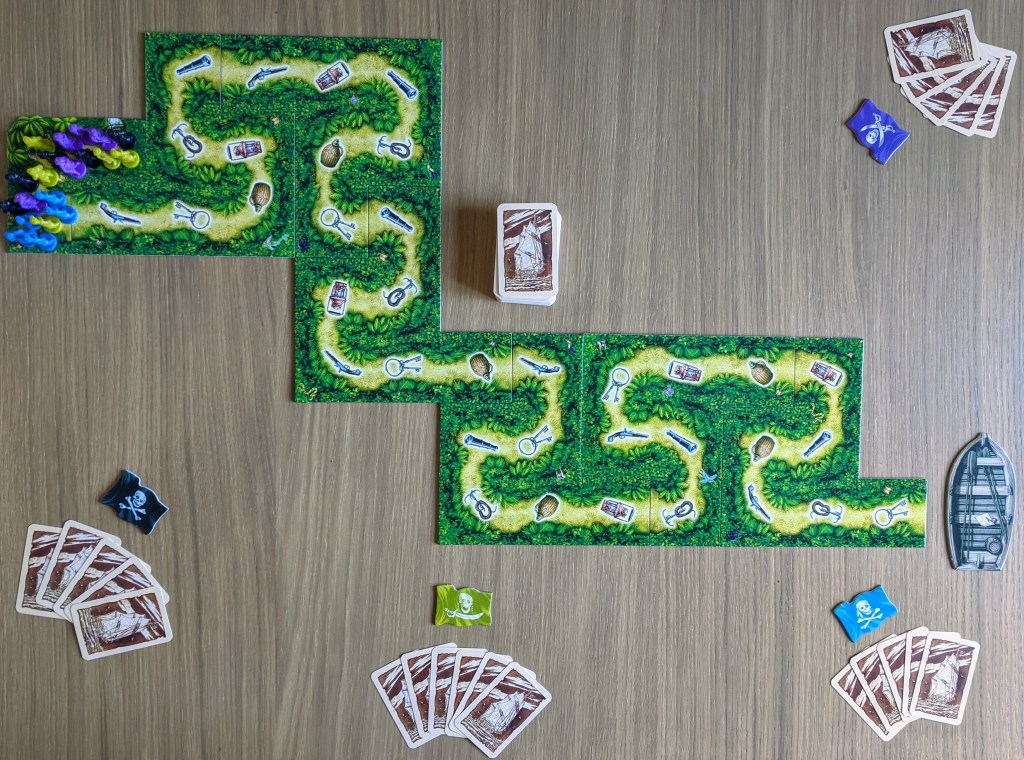
The starting setup for a 4 player game, with yellow the starting player. The pirates are at the meeting place ready to begin their escape to the boat moored at the end of the route.

The item cards include traditional goods for pirates on the run, including bottles of rum, keys, lanterns and grapple hooks. During a turn a player takes three actions, which can be used to either move one of their pirates forward towards the boat and freedom or retreat one of their pirates, allowing them to draw new item cards from the deck.

Playing an item card allows you to move one of your pirates to the next square on the path that features the matching item but no other pirates. In this way, large chains can be built up when several squares with the same item are occupied along the route, enabling pirates to skip the occupied square(s) and travel large distances by playing relatively few cards.

To retreat, a pirate must move backwards to the first square on the track occupied by either one or two pirates. If you join just the one pirate, you are then able to draw a card, and if you join two pirates, you may draw two. Once an item has three pirates on it, then it is deemed full and you must ignore it when retreating.

A player may use their three actions in any fashion, such as on the same pirate or three different ones; they could also mix retreating and advancing, or travel in the same direction three times. Once a player has used their three actions, their turn is over and play moves clockwise to the next player.

Why play it?

Cartagena is simple to learn, good fun and really competitive. In general, you have to try and stay with the group, where many people using the same items will increase the distance you travel and give you more opportunities to retreat and collect more cards. You will want to avoid letting one or two of your pirates getting left behind, otherwise your chances of victory will be slim, even if you have your other men ready to go on the boat!

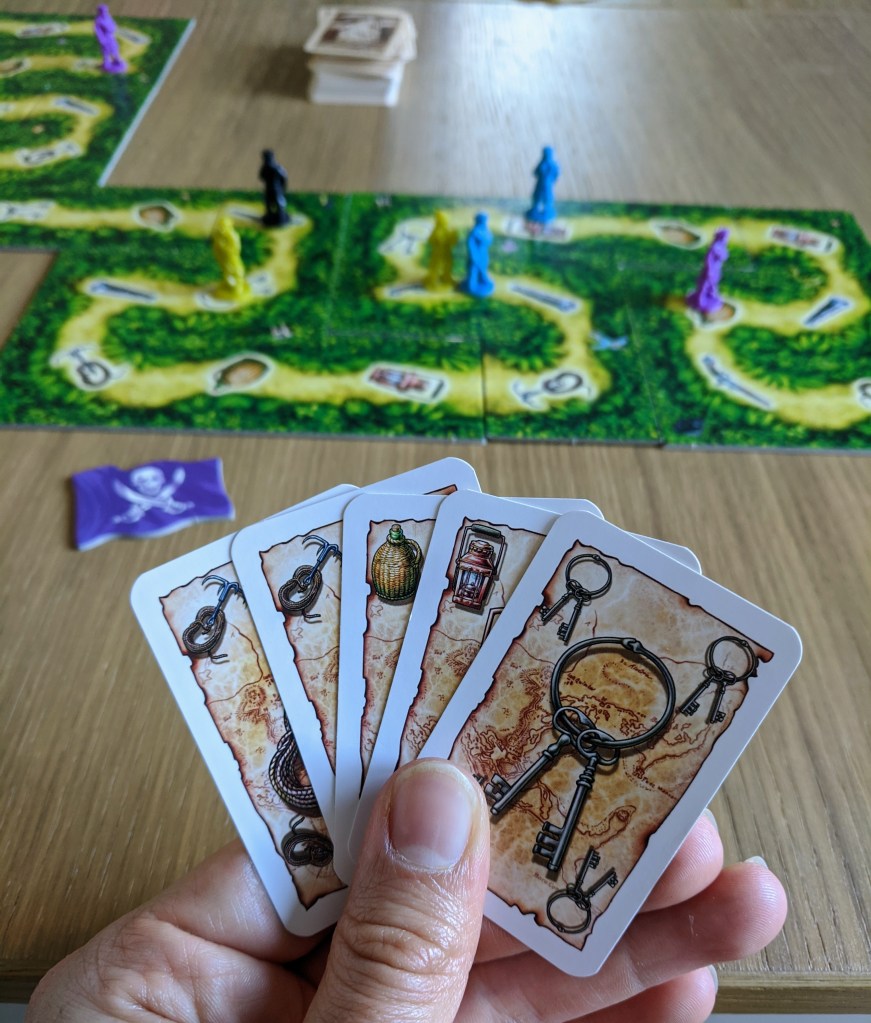
Grapple… Grapple… Bottle … Keys… – Does one of these items get your pirate to the boat quickly?

The ‘chaining’ of a specific item to let pirates travel long distances is a clever mechanic that can really boost your chances of victory, but you’ll need to remember to pull up the ladder behind you to stop competitors from doing the same! It also leads to sudden rushes of popularity for certain items at different points in the game, and it can cause great joy if you pick up one of these items at the right time.

Since the position of other players’ pirates has such a big impact on your strategy, it pays to notice what others are up to. You will find yourself carefully calculating what your three actions will be on the basis of your opponents’ moves, only for the player to your right to grab opportunities you had in your sights – perhaps the chance to pick up two cards without retreating too far – leaving you to hurriedly rethink your next move. That said, there is no doubt the player to your left will have similar frustrations!

Cartagena has been released under a variety of editions by different publishers but the rules have always been similar. Here we are looking at the Ravensburger German edition.

As players desperately hope to pick up a specific item to get their last pirate on to the boat, the players who look like the favourites to win are often pipped at the post during the final round.

Verdict?

Cartagena appears straightforward enough, but your turn can be a real brainteaser. Once you start playing a game, you’ll become very invested and you’ll really want to win!

Timeline

2–8 players and 15 mins.

“When was the launch of the first satellite?”

“Oh, that’s easy, the ’50s or ’60s?”

“And when was the steam engine invented?”

“Err, some time in the 1700s…”

“And the toothbrush?”

“Ok, now that I do not know…”

How do you win?

Place all your cards in the timeline in the correct chronological order and be the first player to empty your hand.

How do you play?

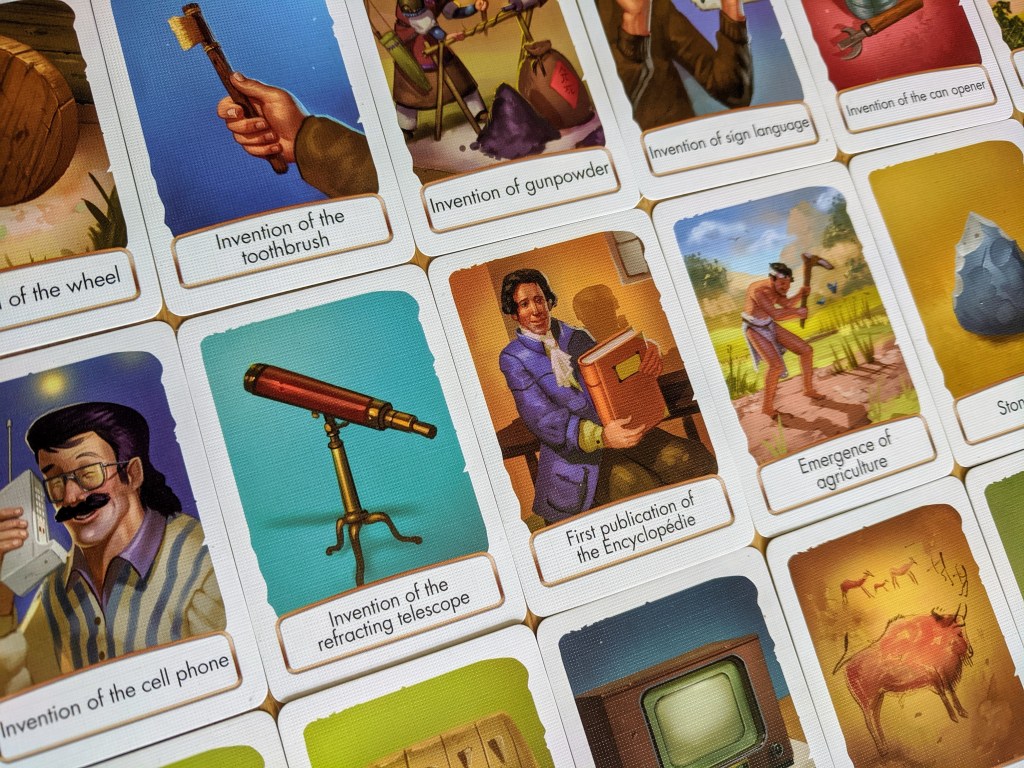
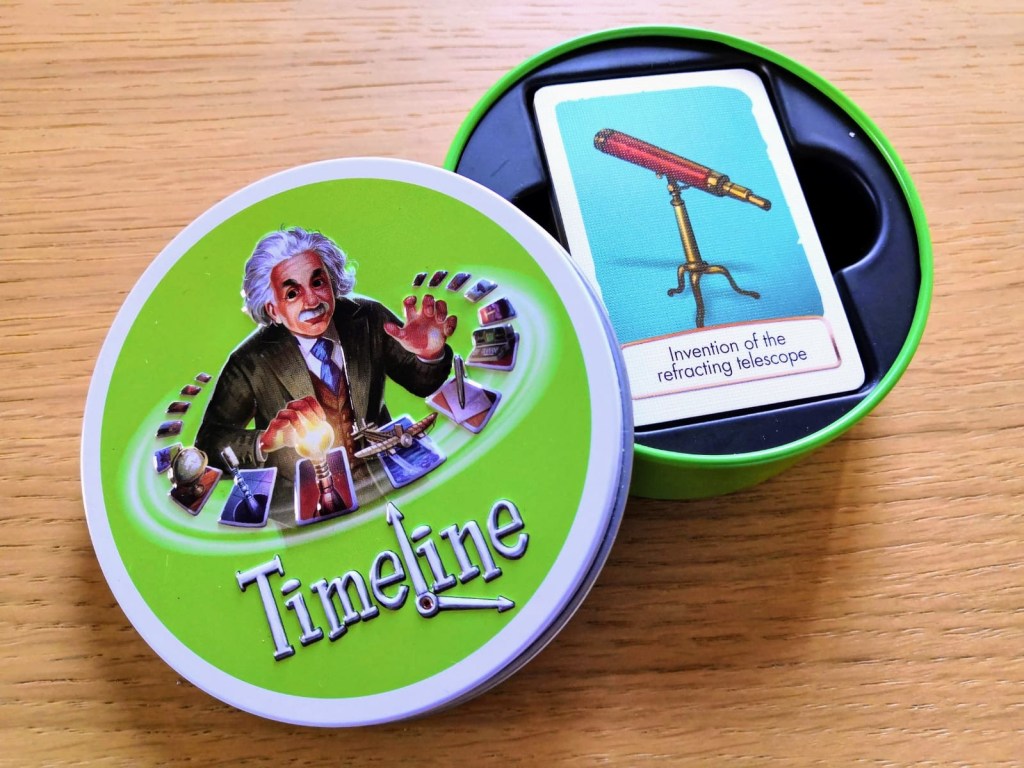
Each card in the game deck shows an invention, with the year the item was invented on the back. Each player is dealt 4 cards (the side with the date is face down!) and one card is placed in the middle of the table with the date face up to begin the timeline.

The first player places one of their cards on either side of the starting card in order to guess (or not guess if they are a smarty pants!) the chronological order in which the inventions were made. If they play to the left of the first card, they believe the item was invented before the date on the starting card, while placing to the right indicates they believe it was invented at a later date.

The player’s card is then turned over and the date revealed. If the player was correct, the card stays in the timeline. However, if the card was placed incorrectly, then it is discarded and the player draws the top invention card from the deck. Play then moves clockwise to the next player.

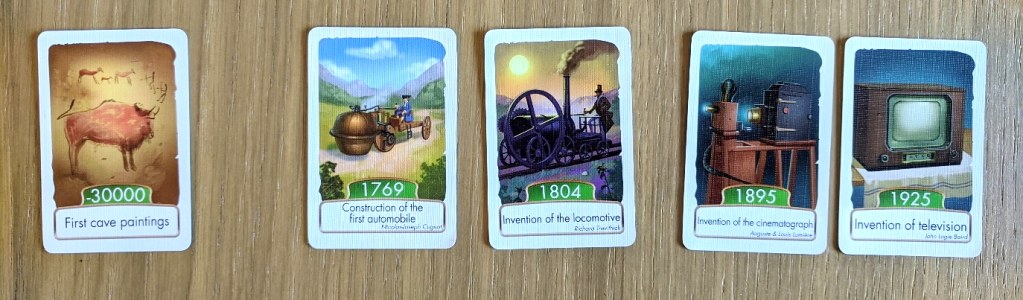
The timeline begins to form after a few cards have been placed and their dates revealed.

As play continues and cards are correctly placed, then the timeline begins to fill up and cards must be correctly placed in relation to ALL the cards in the timeline. This means any cards you hold on to or draw later in the game are harder to place as the game progresses.

Why play it?

Typically, you’ll have a vague idea of where a couple of your cards belong in the timeline and lucky guesses may get you through your other cards, although you’ll need to watch out, since an incorrect guess can leave you drawing a card that is far more difficult to place – something that can be very satisfying to watch an opponent do!

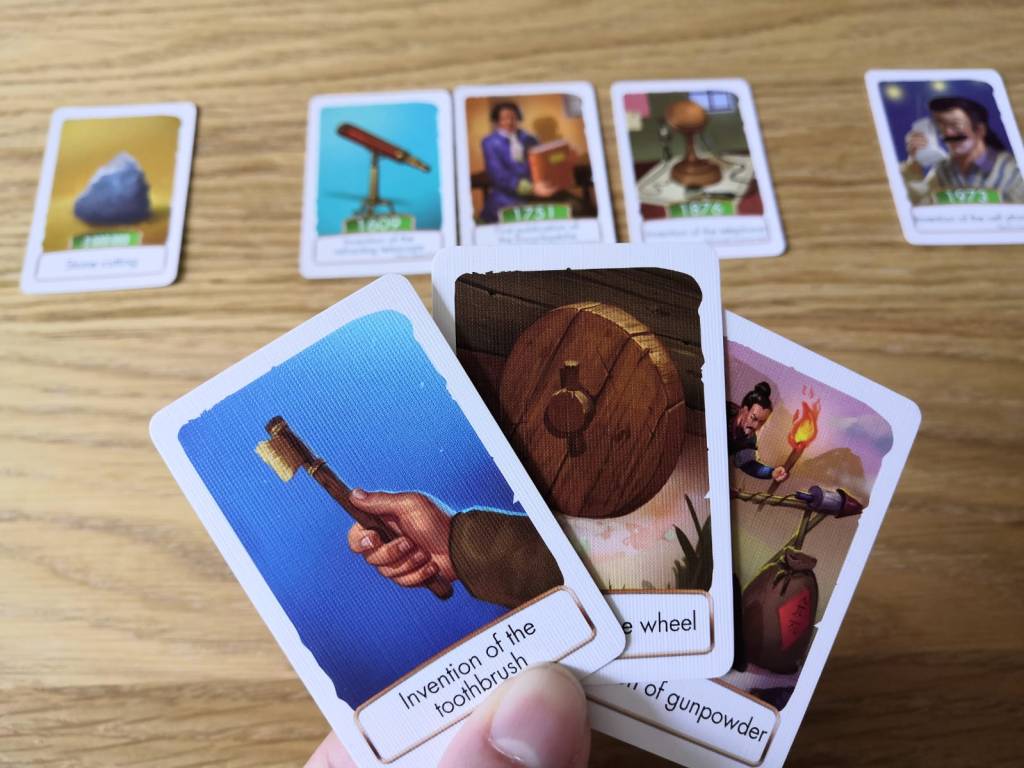
Where would you place these inventions in the Timeline?

A common tactic is to hold on to the cards which you know the dates for, or at least have a rough idea of, since they can then be placed in the timeline to guarantee victory towards the end of the game, unless you are very unlucky and have to guess which came first, the match or the toothbrush? Spoiler: one of them was around for 329 years before the other came along! One of many interesting facts you will pick up throughout a game of Timeline and it can be funny to see people’s logic, such as pondering whether the Romans did indeed use toothbrushes.

Although we are looking at ‘Timeline: Inventions’ here, there are many different varieties to suit a whole host of interests, so if inventions aren’t your thing, take your pick from Events, British History, Discoveries, Music & Cinema and even Star Wars. A neat quirk of Timeline is that different sets can be mixed and matched (perhaps with the exception of Star Wars …), so you could combine Music & Cinema with Inventions and find yourself debating which came first, the mobile phone or ABBA’s Mamma Mia?

On the rare occasion two dates match, you are allowed to place the card either side of the existing date on the board. This can be a lucky escape, particularly for the Music & Cinema edition, which is a little more packed in the late twentieth century than inventions are!

Verdict?

Timeline is a quick and cheerful little game that, although officially competitive, can leave the group collectively floundering and flustered over impossible and poor guesses! Any plans to memorise the answers for future games are quickly forgotten the moment the cards are shuffled and the cards packed up in the box.

Scotland Yard

3–6 players and 45 mins.

Detectives mill around, wondering how he managed to escape their grasp. They were so close, but the trail has gone cold. One detective loiters at a bus stop, another at the entrance to a tube station. Then, suddenly, the alert comes in:

“Mr X spotted at Embankment, all officers required, relocate immediately…”

And the chase is back on.

How do you win?

The detectives win if any member of their team lands on the same numbered tile as Mr X. If you are Mr X, you must evade capture for 24 turns or until the game reaches a point where all detectives are unable to move.

How do you play?

One person plays as the mysterious Mr X, a criminal mastermind on the run. The rest of the players are detectives racing across London in order to catch him. The city map is overlaid with numbered tiles, all connected by coloured links representing various forms of transport, such as a taxi (white), bus (blue) and underground (red). Players have tickets to use for each transport type, for example, a bus ticket will get you from the bus stop at your location to the next numbered tile on the blue route.

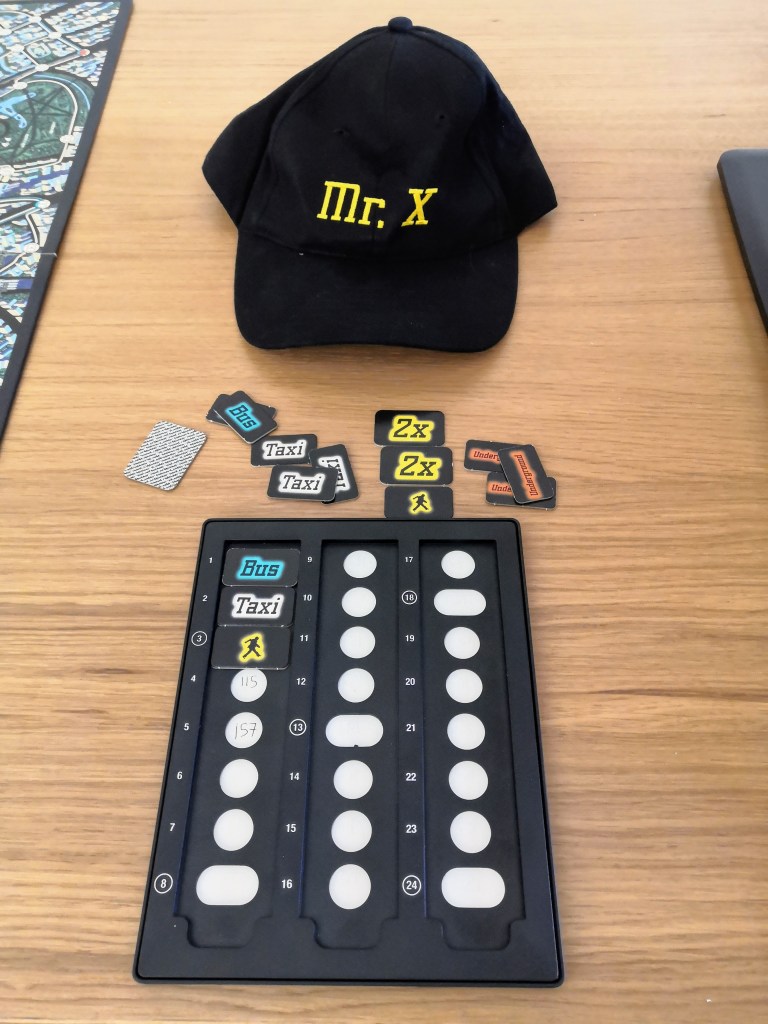
The detectives can comb Mr X’s Travel Log for clues, while Mr X acts casual in his stylish headwear. Mr X must reveal his location when the game reaches the circled turns.

During a turn, the elusive Mr X will travel one stop in secret from his starting location, before writing the number of his destination in his Travel Log and covering it with the type of transport ticket used. The detectives have access to the finished log, giving them a chronological list of Mr X’s transport choices. Play then moves clockwise, as each detective decides where to move by spending an appropriate ticket.

It is worth noting that the police transport budget is critically underfunded and detectives are also incapable of using any form of transport that doesn’t involve wheels and an engine. When an officer dips into their limited stash of bus, taxi and underground tickets, the used tickets are passed on to Mr X, ready for him to use.

Therefore, the detectives risk becoming stuck at a location if they run out of tickets for the type of transport that serves their current tile; a bus ticket will do you no good if a taxi ride is the only way you can leave your location. In general, underground tickets allow travellers to cover the furthest distance in one turn, but officers have less of them to use compared with bus and taxi tickets.

The key milestones of the investigation are five set points on Mr X’s travel log, where he must reveal his current location. This gives valuable information for the police to work with – hopefully, thanks to good planning and/or luck, they are in the vicinity and have the right transport tickets to get them there in time to catch their prey! If they arrive too late, they will attempt to deduce Mr X’s escape route on the basis of the transport methods shown on his Travel Log and his last known location.

The travel tickets for the detectives and the map of London in all its glory.

Why play it?

Scotland Yard involves a tense rivalry, with the detectives trying to plan ahead and act on limited information to outwit Mr X. Meanwhile, our suspect is attempting to cover his tracks and give as little away as possible in order to keep the law at arm’s reach.

Although the detectives have the advantage in terms of numbers, there are a few other mechanics to assist Mr X. For example, he is free to observe all the detectives’ movements and listen in on their plans (unless they come up with some unspoken or coded methods of communication first!). As a detective, it can be easy to forget that your target is witness to your conversations, with your thoughts giving him new ideas on how to escape!

In addition to Mr X’s unlimited supply of travel tickets, kindly provided by the detectives, he also has special tokens at his disposal, such as ‘double move’ tokens. Mr X can also spend a ‘mystery movement’ token, which allows him to keep his transport method secret from the police and can be used for any type of transport, including a handy river boat that is not available to the police (budget cuts strike again!). These special tickets are typically used by Mr X to muddy the waters right after he has revealed his location, allowing him to quickly escape as the police close in.

A well-loved copy of the game

During a typical game, there are several moments when the police can feel like they don’t have a clue where the suspect is; meanwhile, from Mr X’s perspective, the detectives are far too close for comfort and capture seems imminent. To survive for long enough to win the game, Mr X will have to double back on himself or gamble by visiting tiles adjacent to detectives, hoping their paths won’t cross. Anything to avoid the dreaded dead ends on the map!

Verdict?

A co-op game that still involves tense competition. Older games can sometimes fall flat compared with more recent releases, but Scotland Yard certainly delivers with its simple yet engaging gameplay.

Patchwork

2 players and 25 mins.

Quilting may seem an unlikely premise for a competitive two-player board game, but don’t be fooled: while Patchwork delivers the creative zen you’d expect from a game based on quilting, it also has a competitive edge that makes it extremely enjoyable to play – it’s difficult not to be drawn into quilting rivalries!

How do you win?

Carefully select the best patches to fill up your quilt board during the game. A large quilt with fewer gaps means less points deducted from your score at the end of the game. The player with the highest score wins!

How do you play?

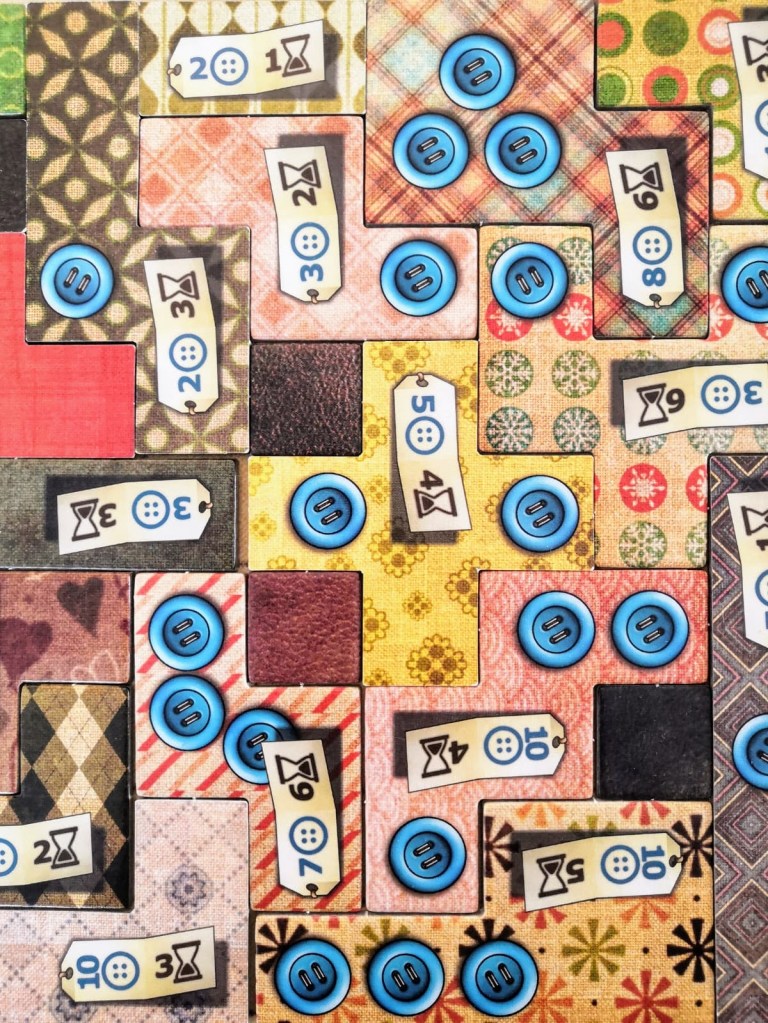
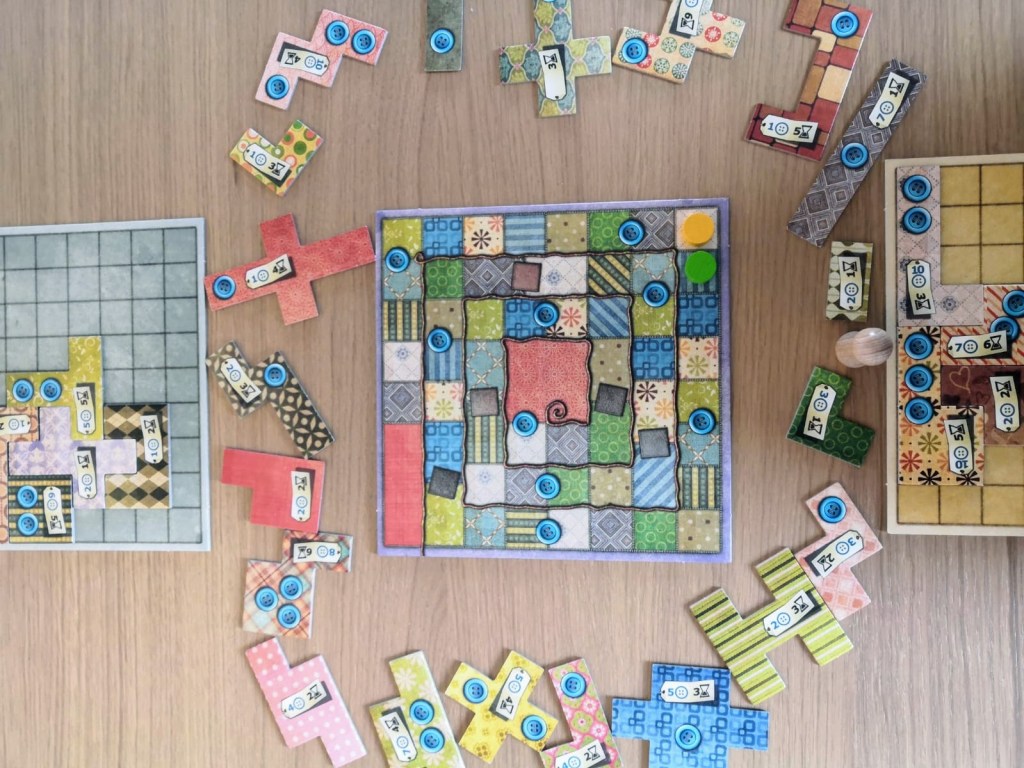
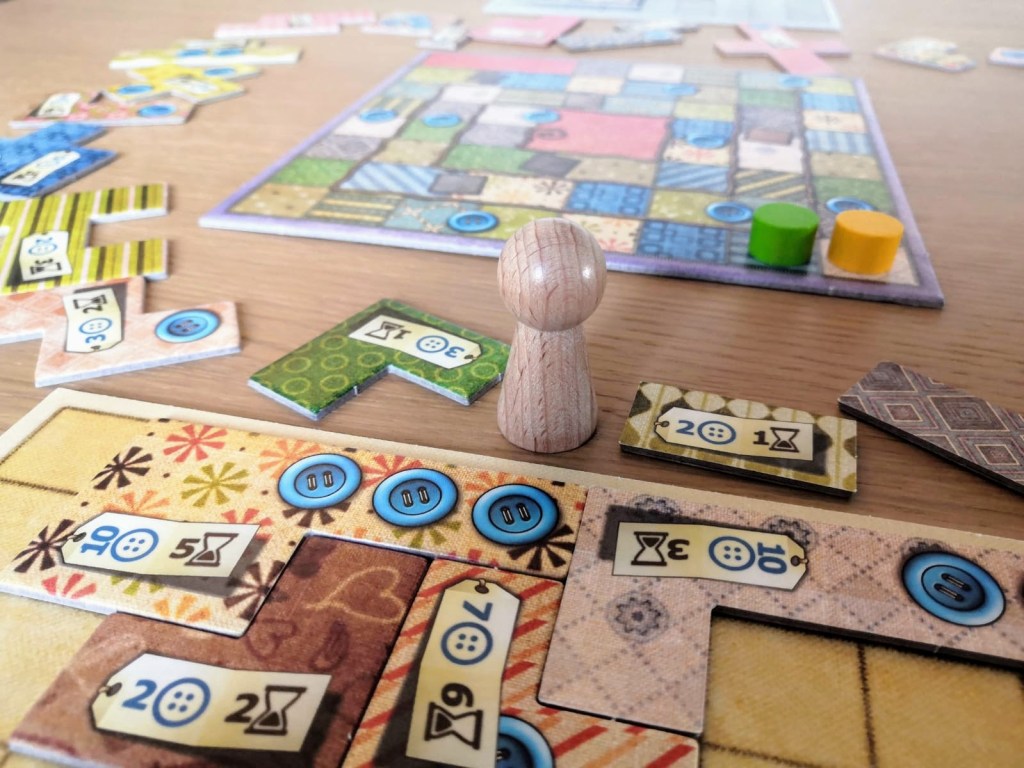
Each player is aiming to complete their quilt by selecting and placing Tetris-like patches on their own nine-by-nine grid, aiming to leave as few gaps as possible. Each patch will cost you a certain number of buttons (the currency in the game) and some of your ‘time’, i.e. a number of spaces that your token must move towards the end of the central game board (and therefore the end of the game).

The patches that the players will use to make their quilts are spread in a circle around the central game board and are different shapes and sizes; some may be a bargain in terms of time or buttons but the patch may be an awkward shape to fit in the quilt, while more expensive patches may result in a payout of precious buttons later in the game, making them worth the investment.

The central game board with the available quilt patches in a circle. Each player’s quilt grid on either side is slowly filling up with their chosen pieces!

Interestingly, players do not necessarily take turns to add a patch to their quilts, since the player whose token is further behind on the central game board keeps placing pieces on their quilt until they overtake the other player. This keeps the game nicely balanced when someone chooses a large, ‘time-expensive’ patch which moves their token forward a few steps, since the other player is able to place a few smaller pieces.

The two tokens follow a path on the central board, with special bonuses triggered when a player’s token passes either a button or leather patch. A button payout awards buttons to a player according to the number of buttons that appear on their quilt, while each leather patch is awarded to the first player to pass it, allowing them to mend a gap in their quilt.

Once both players have reached the end of the board they tot up the total number of buttons in their possession, deducting two points for every gap in their quilt. The player with the most points wins!

Why play it?

Patchwork is a fun, relaxed game that is easy to get the hang of. Piecing together your Tetris quilt is a creative challenge, although it soon becomes clear that there’s more to the game than rushing to claim the bigger, cheaper patches; this approach will leave you with awkward gaps to fill and a quilt that has more holes than a Swiss cheese! A wiser approach is to hoard your buttons and splash out on the pricier patches that can secure a hefty button payout later on – while keeping an eye on your opponent to ensure they don’t pip you to the post.

What will your quilt look like?

The balance between the two resources (time and buttons) is fine tuned to keep both players neck and neck, meaning everything is left to play for even if one of you is running low on buttons or if one token is much further behind on the central board. This usually makes for a close score at the end of the game, making it likely that the victor will be challenged to a rematch!

Verdict?

A firm favourite and our go-to two-player game. It works very well as a game for two players, partly because it was designed with this in mind, where other games seem to provide a two-player option as an afterthought. It’s surprising how competitive quilting can be!

Love Letter

2–4 players and 20 mins.

Dusk stretches into darkness and a candle flickers as a quill scratches over a letter. However, this is no ordinary letter, this is a letter of Love – addressed to the princess herself! The finishing touches are made, then the letter is closed with a kiss and a wax seal.

How do you win?

Win a round in order to successfully deliver your letter to the princess and receive a Love Cube. The first player to collect a certain number of Love Cubes, which varies with the number of players, wins the game.

How do you play?

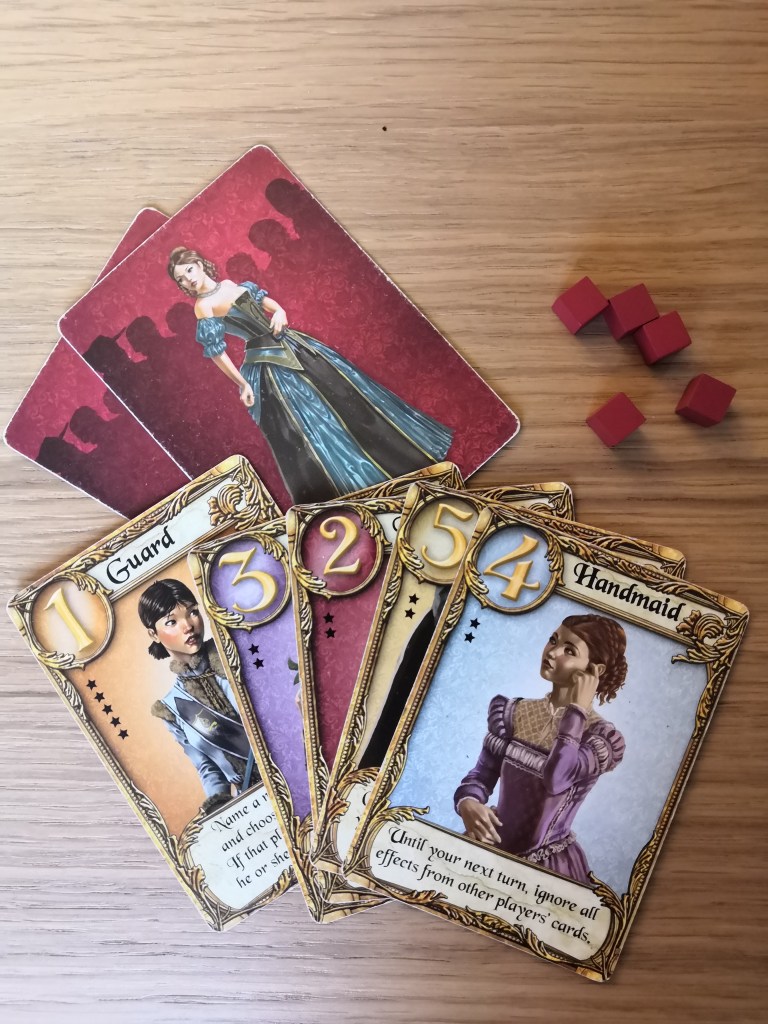
Each player is dealt a card and one card from the deck is removed from play. Each card has a character, a points value and an action on it. The more important a character is, then the higher the card’s points value, from the Princess at 8 points down to a Guard with only 1 point. You will use these characters to get your letter to the princess and they include different people such as the Priest, the King, a Handmaid and the Countess. There is only one card of the most valuable characters, but there are five guard cards, and two cards of most other minor roles between.

On a turn a player draws a card then decides which action from their two cards to play. Each of the nine characters has a different action, ranging from looking at another player’s hand (the Priest) to trading hands with someone else (the King) or guessing which card a person may hold and knocking them out of the round if correct (the Guard). The action of the chosen card is carried out, then the next player draws a card and decides which action to play from either of their two cards. This continues until either one player is left in the round, the others having all been knocked out, or if the draw deck runs out, then whoever holds the card with the highest points value wins.

Five different character cards shown, with each unique action at the bottom. The coveted Love Cubes are at the top of the picture!

Why play it?

The nuts and bolts of the game is using a Guard action to guess what another player may be holding. A lucky guess will knock that player out of the round and leave you feeling very satisfied, while an incorrect guess can still provide valuable clues. The game is all about collecting knowledge and using it in time before another player’s hand is redrawn.

Clues come from the character action you play or what other players do, such as noticing a particular character somebody has discarded, which they may have been forced to do depending on their hand. The race is on as everyone will then scramble to use this information against that player before he draws new cards, unless he was just teasing all along to draw out an incorrect guess from an opponent!

The neat little velvet bag the game comes in. The white version at the top of the page is a special wedding edition only available for those attending a wedding!

As the rounds progress, players will gang up on each other in order to knock players out, only to then quickly turn on each other to make the most of any knowledge among the group. Another quirk of play is that if somebody is (un)lucky enough to start with the Princess card, or pick her up during play, then they must work hard to avoid discarding her for the whole round, otherwise they are knocked out. This can lead to some tense moments, or to some assuming a nervous-looking player must be holding the Princess, only to be proved wrong when placing a guess.

A final word, remember that one card removed from play? This adds an element of unpredictability on each playthrough as any character card may have been removed – including the Princess herself!

Verdict?

Love Letter is a fun, highly replayable little game; great to play when travelling and not just because of the neat little velvet bag the game comes in! Also works well as a two-player game, but best with four.

Skull

3–6 players and 15–45 mins.

Cigarette smoke lingers in the air. Glasses are nearly empty and the room is silent.

“Five…” “Pass…” “Pass…”

The first man begins to turn over the other players’ beer mats. He reveals a flower. Then a second flower. He mulls over which to choose next. He hesitates. Then casually flips over his third choice and reveals a…

S K U L L.

And with that he is cursed. And out the game.

How do you win?

Reveal as many cards as you bid without revealing a skull card to win a round. Win two rounds and you win the game.

How do you play?

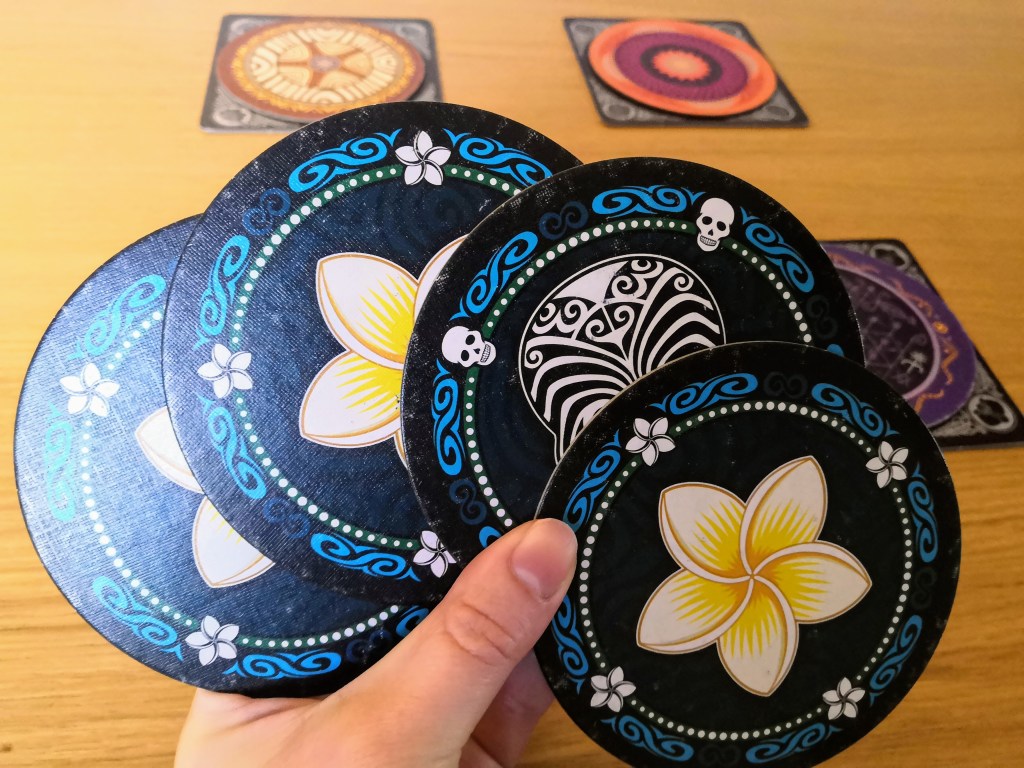
Each player has a hand of four beautifully illustrated cards which consist of three flower cards and a skull. The first player puts one of their cards face down on a mat in front of them. Moving clockwise, the next player then places a card of their choice face down. Once play returns to player one, they now have a choice: either lay a second card on top of their own or begin the bidding.

Bidding means stating how many cards you think you can turn over without revealing a skull card. Once a player begins bidding, play moves clockwise as each player is allowed to either pass and bow out of the round or increase the bid by at least one card. When the bid reaches the total number of cards in play or all players have passed, then the player who won the bid begins to reveal cards.

Flower… Flower… Skull… Flower. Which will you lay?

They reveal their own card(s) first, then choose cards from any other players, from the top of their pile down. They do not have to take all the cards from a player; they may alternate between players, but they must turn over the number equal to their bid in order to win the round. However, if a skull card is revealed, even from their own pile, they immediately lose the round and a card is permanently discarded from their hand at random.

Why play it?

Skull is an intriguing little bluffing game which works perfectly with a few drinks on a late night. It’s not hard to believe the stories of the game’s origins, being played on beer mats by bikers or by adventurers in exotic lands.

Things begin calmly during the laying phase, with people playing mind games and acting casual as to when or if their skull is being placed. While keeping a keen eye on the other players, you have to decide whether to place your own.

Intricate artwork on the box.

The moment bidding begins, the game is suddenly tense. A second player snaps with a higher bid. All the other players start to analyse…

Can they do it? Are they bluffing? Whose cards would they choose to uncover? Could I beat them?

Then after much deliberation, the next player ups the bid. They are now the centre of attention.

Are they just bluffing? I think they can do it! Why didn’t I lay my skull for them?!

Once a player wins the bid, the tension lingers as they reveal cards. You may desperately hope for them to discover your earlier laid trap of a skull and all will rejoice if they do! Other times the group is shocked when it is revealed there were no skulls after all – and the losing players are left wishing they had followed their instincts and continued to bid!

One of the highlights of the game is definitely if a player wins a bid they don’t actually want to win, after trying to look keen during the bidding phase so as to lure somebody in. This gamble can leave them cursing themselves with their own skull!

Verdict?

Skull is a highly replayable and enjoyable game which replicates the bluff and tension of a poker game with a simple set of rules – and a little luck thrown in.

Saboteur

3–10 players and 30 mins.

There are rumours that gold lies under the mountain, and a team of dwarfish miners is determined to find it. They are working together to tunnel towards the gold, but there’s a catch: one or more saboteurs want to lead the group astray so that they can claim the treasure for themselves. Will the saboteurs successfully pull the wool over the eyes of the miners and keep them from their prize?

How do you win?

For the miners: Tunnel until you reach the coveted gold, avoiding the two lumps of coal if possible!

For the saboteurs: Ensure that the miners don’t reach the gold.

How do you play?

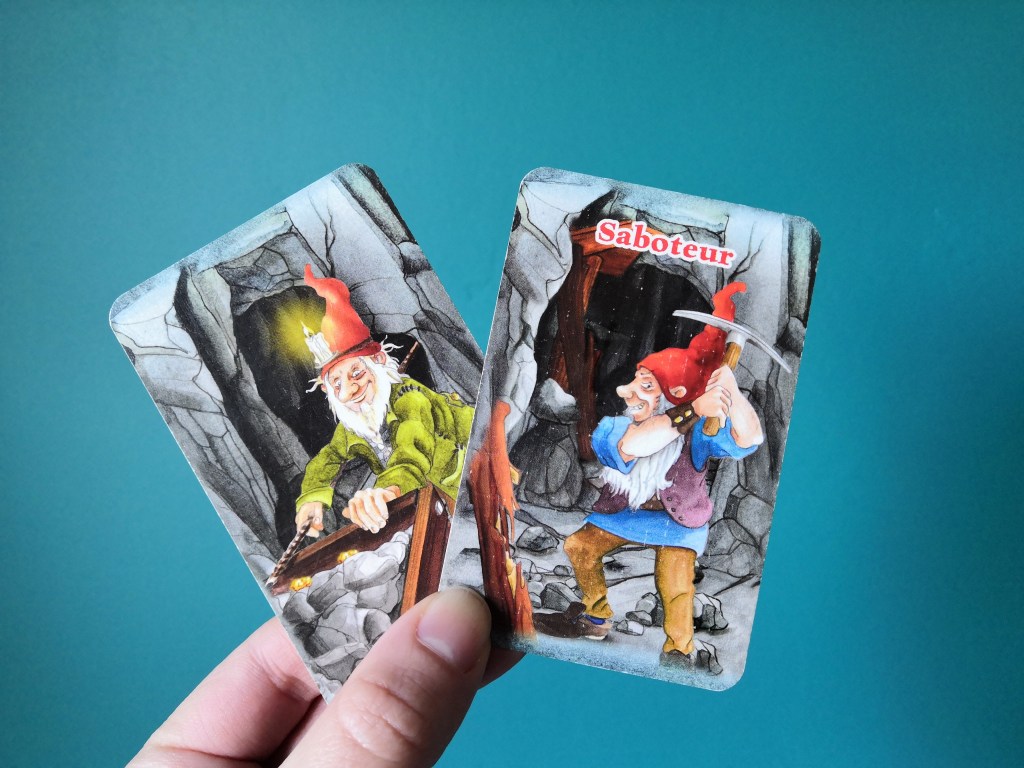
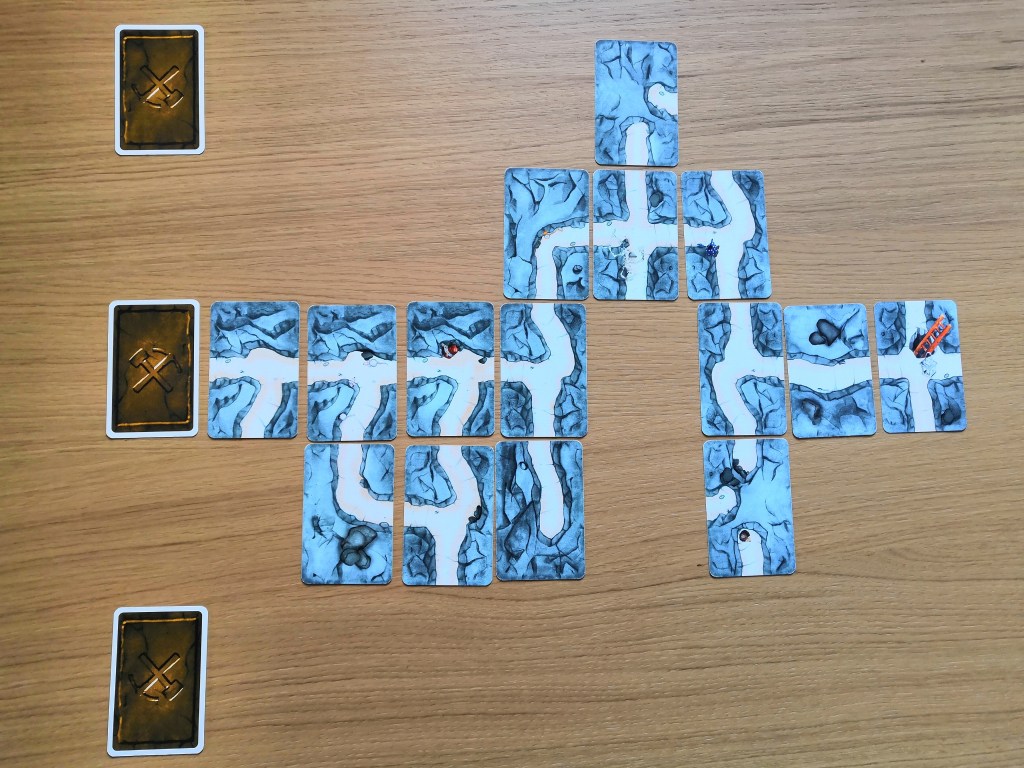
At one end of the tunnel is the mine entrance, and at the other are three face-down cards: one is the gold, the other two are coal. Players take it in turns to lay a tunnel card, starting from the mine entrance and gradually building a path towards their goal. The tunnel cards include helpful cards like crossroads, as well as dead ends, twists and turns. Each player has been dealt a role, which they keep secret: most players are well-intentioned miners; they want their tunnel to reach the hidden gold. The saboteur(s), on the other hand, win if the tunnel cards run out and the gold cannot be reached.

The miners have built a tunnel leading from the mine entrance on the right to what they hope is the gold – turning the card over will reveal whether they have made the right choice!

So, where does the sabotage come in? Well, the saboteurs can take advantage of a few things. Instead of laying a tunnel card, you can play an action card. One of these, the ‘map’ card, lets you peek at one of the three prizes you are mining towards – whether you tell the truth about the location of the gold is up to you! ‘Rockfall’ cards let you remove one of the cards that makes up the tunnel, forcing the miners to rebuild by finding a tunnel card that fits the gap. Players also have the option to discard a card from their hand face-down instead of building the tunnel, allowing good miners to get rid of any awkward tunnel cards and saboteurs to ensure that handy crossroad cards go unused. Finally, any player can lay a ‘curse’ card in front of another player; these cards prevent them from laying more tunnel cards until they are released from the curse by another player (or by themselves).

Why play it?

Part of the fun of the game is working out the identity of the saboteur(s) – did that player lay a tunnel card that forces us to the right to lead us away from our destination, or were they making the most of a bad hand? Two players have used a ‘map’ card to peek at the same card, but one claims it is coal while the other insists that it is the gold – who is more trustworthy?

Being a saboteur is just as enjoyable; unusually for a bluffing game, you begin the game not knowing who else is on your team, so working out which other players (if any) share your ambition of failing the mission will be the first part of your challenge. You have plenty of options for sabotaging the rest of your team; the key is to balance the havoc you can wreak against the benefits of keeping your identity hidden for the time being and winning the miners’ trust.

The best games are the ones where uncertainty reigns and curses are flying left, right and centre; if the saboteurs play their cards right (no pun intended, honestly), they get the miners fighting among themselves so that they can sit back and let the chaos do their job for them.

Verdict?

It’s difficult to resist getting drawn into a game of saboteur. Best played with more players (maybe 7 or 8), as this allows two saboteurs to work together. 

Celestia

3–6 players and 30 mins.

All aboard! We are going on an adventure! So begins an epic voyage on board an illustrious airship to new worlds where you may disembark and collect intriguing souvenirs to bring home. Although the journey is not without risk; violent winds or vicious birds could bring down the ship before reaching the next destination.

How do you win?

Collect enough treasures from each world to make it to 50 points. The player with the most points after this declaration wins!

How do you play?

Players are dealt action cards which have symbols, such as lightning or clouds, which correspond to those shown on the challenge dice. The nine worlds are set up in a line, with the treasure cards next to each one. All passenger tokens are placed within the airship, which starts at the first world. The passenger who starts as the captain must roll the challenge dice. Each player in turn then either votes to stay aboard the ship for the journey, or may leave and collect treasure from the world the ship is currently at.

Once all players have decided to stay or go, then the captain must play cards with the corresponding image of the dice roll challenges if she has the correct action cards. If she is able to do this, then the voyage moves to the next world and the captain role passes clockwise. If she does not have the appropriate cards, then the voyage fails and restarts from the first world, with each player drawing an action card.

As the voyage goes on, more dice must be rolled, making the captain’s job more difficult, although the value of treasure does increase with each world. Before each passenger decides to disembark or remain, they may question the captain, who may be tempted to be economical with the truth in order to bring others down with her or encourage others to leave early to allow a smaller number of people the riches.

Special cards add an element of unpredictability and the potential for friendly grudges, such as a free pass card that a captain is not obliged to use, or a hook card to remove another passenger against their will.

Why play it?

Celestia blends bluffing and luck in a very satisfying cocktail. You can be left at the second world watching the airship you had believed to be doomed somehow overcoming challenge after challenge with just a sole captain aboard; yet other rounds, the whole crew is unable to make it past the first challenge – typically owing to everyone’s vested interests in keeping cards for themselves rather than using them for the greater good, until enough passengers have lightened the load!  All in all, Celestia is a neat game that feels very fun and very replayable.

Verdict?

A great little game that blends luck with bluffing effectively.

Design a site like this with WordPress.com
Get started