Wavelength

2 – 12 players and 30-45 mins.

To what extent is Haribo for kids or for adults? Is a parrot an exotic pet or actually quite a normal one? Are skirts masculine or feminine? Be prepared to discover some new perspectives from friends, or to justify your ‘obvious’ clues to them!

How do you win?

Win points by getting your teammates to guess the correct location on a scale between two extremes using just one clue. The first team to reach 10 points wins!

How do you play?

Divide into two teams.

One person on the first team draws a card which will define a scale for the board, such as ‘hot’ to the left and ‘cold’ to the right, or ‘for kids’ on one side and ‘for adults’ on the other. They then place the card at the front of the wheel and set up the spinning device by closing the covering window, spinning the white wheel to randomise the ‘target’ zone, then re-opening the covering window.

The player must then say a word or phrase which they hope will indicate to their teammates where the target slice is located, then stay silent for the remainder of the turn. After hiding the location of the target with the covering window, the clue-giver shows their team the spinning wheel, and the discussions begin!
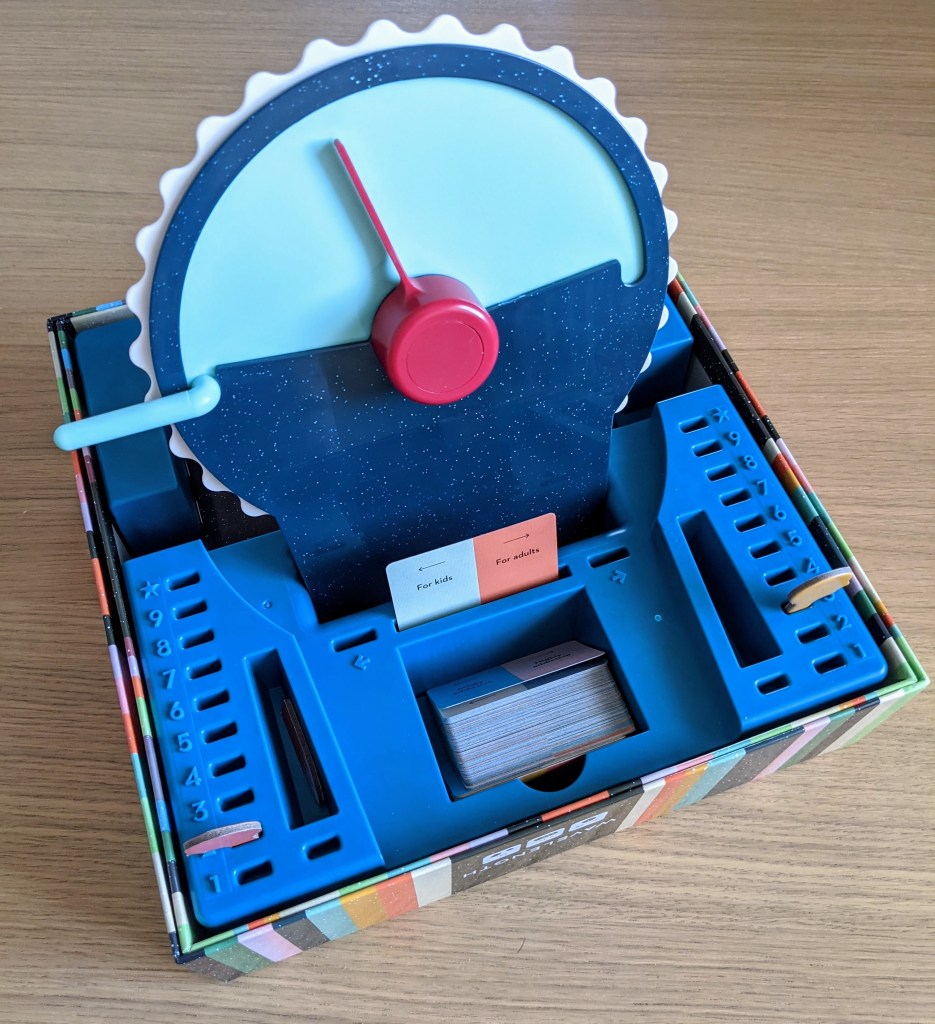
The teammates will see a wheel like this. They must decide where to move the red dial to try and score points. In this case the clue is ‘Haribo’ – would you move the red dial more towards ‘for kids’ on the left or ‘for adults’ on the right?

The team will then decide where to move the red target marker according to the clue. In the case of ‘for adults’ vs ‘for kids’, the clue may have been ‘doing taxes’, which suggests moving the dial to the far right-hand side. Alternatively, saying something such as ‘plastic ball pit’ would suggest moving the dial more towards kids (“but I love ball pits!”, one adult team member will inevitably pipe up). If the target were somewhere more central, a more nuanced clue which could apply to either side would be needed such as ‘Haribo’ or ‘video games’.

Once the team has guessed a location for the red dial, the other team gets the chance to earn a bonus point by guessing whether the 4-point marker is located to the left or right of the first team’s guess. The screen is then revealed and points are awarded.

The screen is opened to reveal that the team wins 2 points for their guess! If the team had scored a 0 and the other team had correctly guessed if the 4 points was to the left or right, then they would win a bonus point.

Play then switches to the other team, with a different person acting as the clue-giver on each round.

2. They open the cover and see that the 4 points is located towards ‘Exotic Pet’ rather than ‘Normal Pet.’ They must think of a clue to get their team to move the red dial towards this zone. Perhaps a parrot or peacock? Announce your clue, then cover the wheel for your teammates to begin guessing!
1. Setup for the new round. The clue-giver on the second team gets the wheel, closes the cover and spins the white wheel.

Why play it?

Although the rules can seem a little complicated at first glance, trust us – gameplay is actually quite straightforward! It’s novel how the giant wheel fits neatly into the box, which can be passed around the group.

Since Wavelength is a word-based game, it’s highly replayable. Even an ‘obvious’ clue can be interpreted completely differently by someone else or at least debated fiercely among the group! There is a lot of fun in seeing how your clues are explored, even if sometimes, frustratingly, your team talk themselves out of the right answer!

If you know the other players well, then a new depth of knowledge can really develop for each clue during the gameplay, as in-jokes and personal interests creep in!

Verdict?

An enjoyable and highly replayable word-based boardgame which holds up very well with many players or as a smaller ‘two vs. two’ type game. A co-op version also exists for 2­–5 players and it’s worth playing this version for the first couple of games to introduce new players.
Coloretto

2 – 5 players and 15 mins.

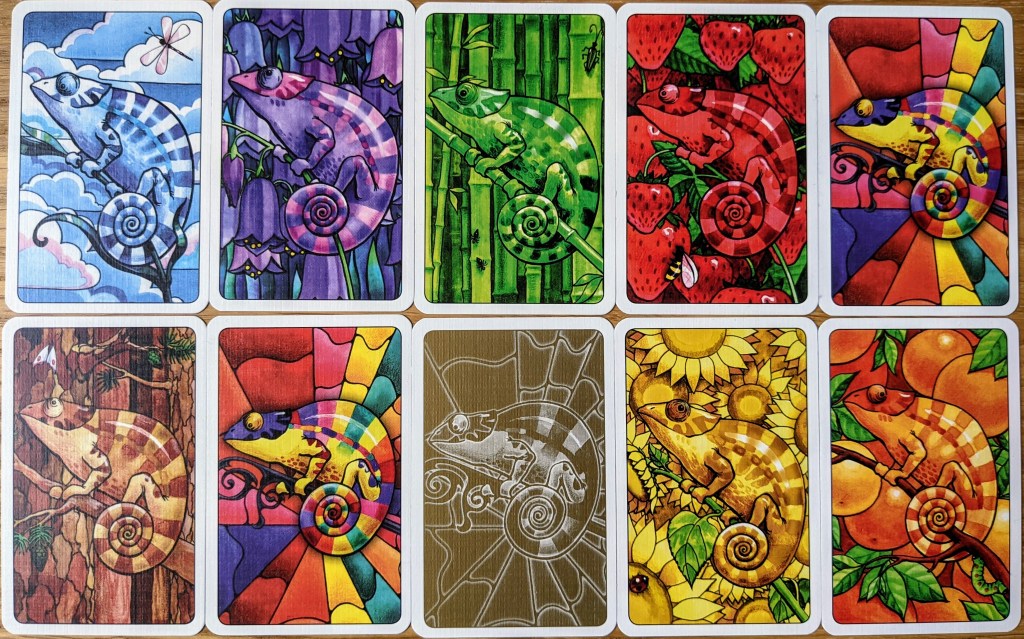
Collect colourful chameleons, gathering as many of the same colour as you can and keeping an eye on your opponents’ growing menageries! Will you be lucky enough to add a multicoloured chameleon to your collection, or even… the hallowed golden chameleon?

How do you win?

Collect as many chameleon cards of the same colour to gain points. Whoever has the most points at the end of the game wins!

How do you play?

There are chameleon cards of different colours to collect within the game, with nine of each colour. Each player takes a scoring card and a chameleon card to start, ensuring that all players have different coloured chameleons. Place the three ‘row’ cards at the centre of the table and shuffle the rest of the chameleon cards to create a deck.  A ‘last round’ warning card is then placed 15 cards from the bottom of the deck, and you’re now ready to start!

The deck also has ‘+2’cards worth two bonus points and three multicoloured ‘joker’ chameleons – if you claim one of these, they can be used as an extra chameleon in a colour of your choice at the end of the game. The special ‘golden joker’ card acts as a normal joker, but also lets you claim a free card from the top of the deck to add to your score pile.

On your turn you may either draw a card, which you place next to one of the row cards in the centre, or take a row card and the card(s) it holds, adding the card(s) to your chameleon collection. Each row can hold up to three cards, but you can claim one before it fills up, which you might want to do if you find one of the cards especially tempting.

Play then moves clockwise, with each player either taking a row with at least one card on it or drawing and placing a card to build a row. Once you take a row, you are out of the round and the other players continue to play – even if only one player is left in the round.

A round ends once all three rows have been claimed. After all players have collected their claimed cards, they return the row cards to the centre to begin a new round.

Play continues until the ‘last round’ card is dealt – play will then end at the conclusion of that round. Players then tot up their chameleons, bonus ‘+2’ cards and jokers. A player selects three of their chameleon colours to score using the scoring card; the more you have of a colour, the better, as scoring is exponential . They then also score up any remaining colours, but these will be translated into minus points!

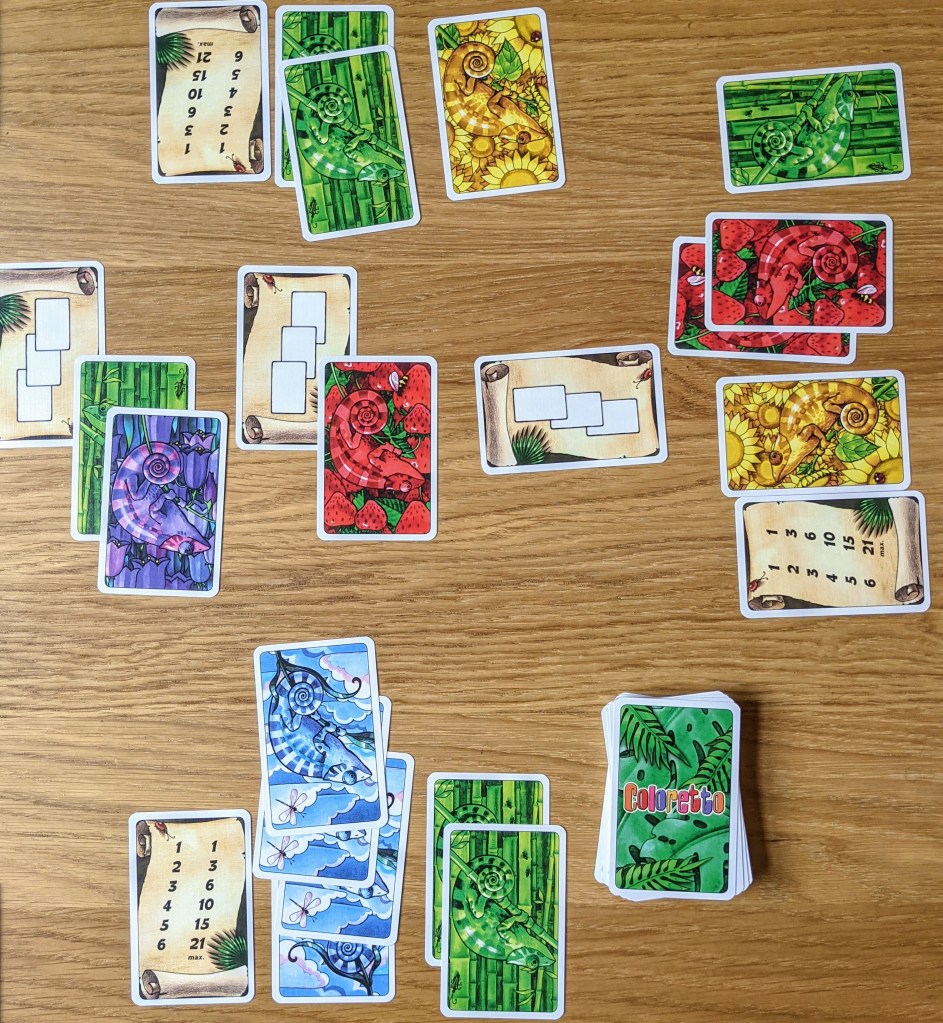
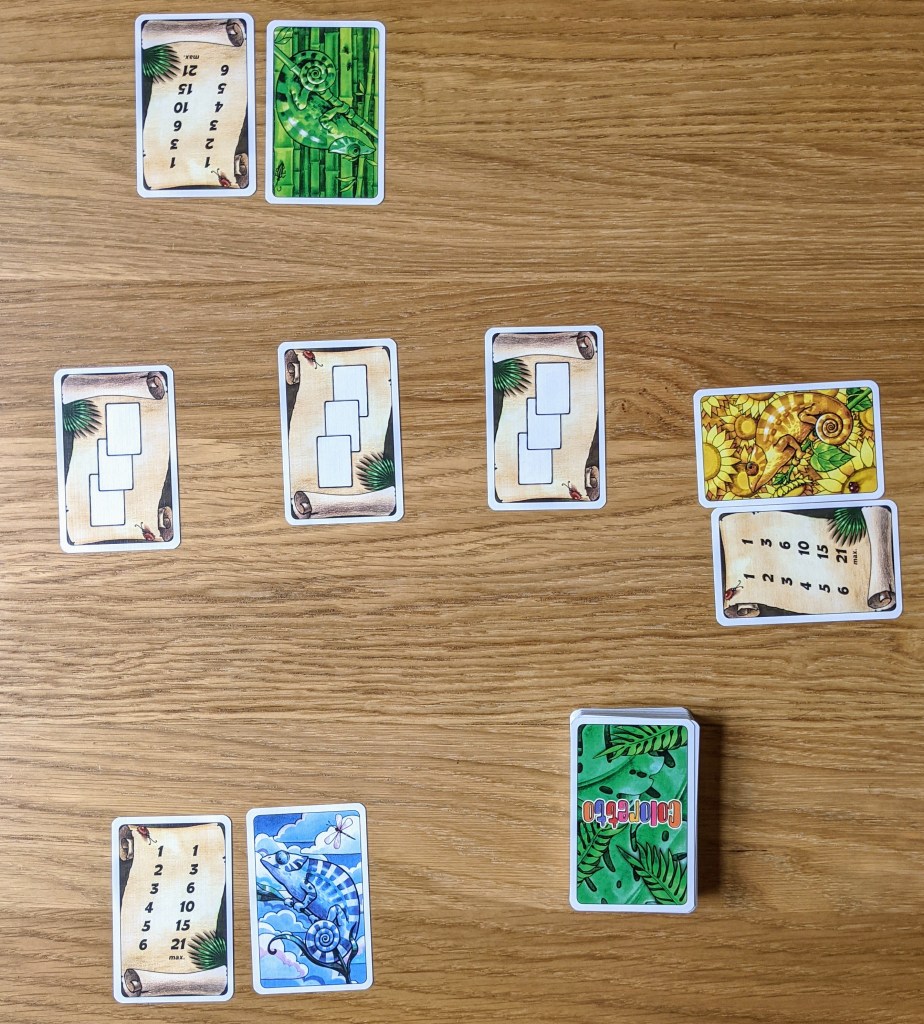
Player 2 (on the right) has just claimed a row and added the chameleons to their menagerie. Player 1 (at the bottom) is deciding whether to take the green and purple chameleons from the left row or to draw a card and add it to either of the remaining rows. To reach a decision, they will also have to take into account player 3’s likely next move…

Why play it?

This game uses the same clever card-drawing mechanic as Zooloretto but creates a whole mini card game from it. Once again, what seems to be quite simple gameplay on the face of it actually leads to an in-depth game of bluffing, luck and strategy against your opponents.

While you might be tempted to create a row with your colours, you don’t want to make a row too attractive by adding too many cards of the same colour, otherwise an opponent will take it first!

When you are the last player in a round, it is always a fun gamble to decide whether you should continue drawing cards on to a row and risk drawing a colour you aren’t collecting, or avoid the risk by making do with less than the maximum of three cards!

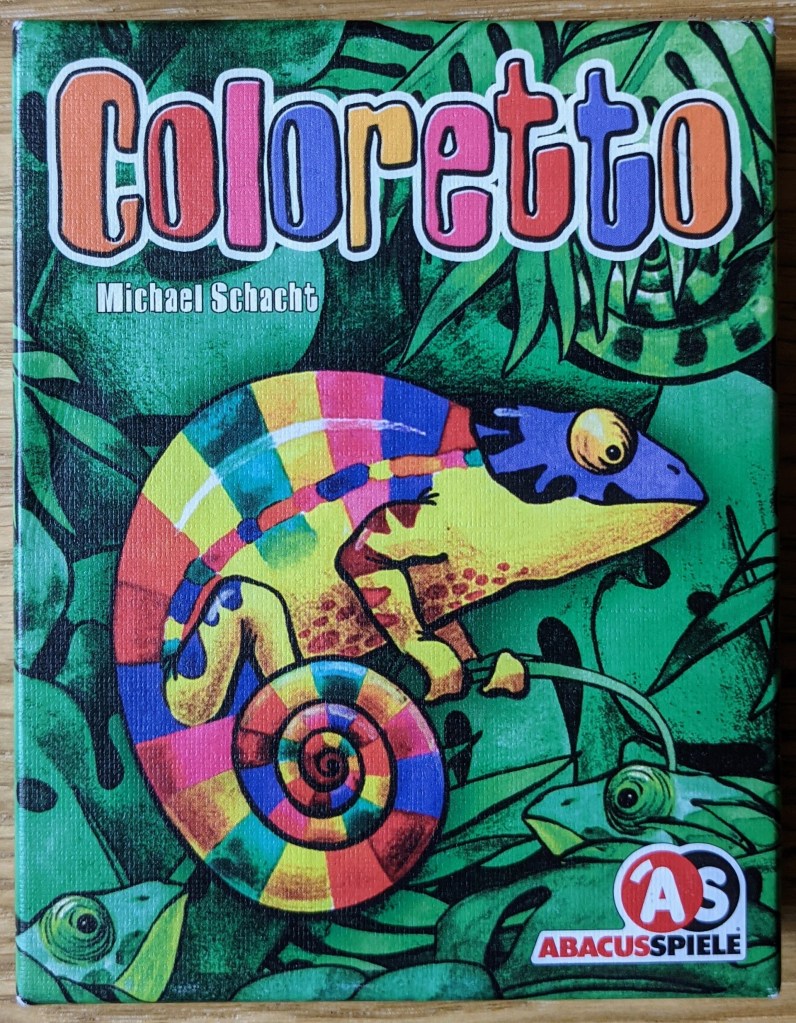
The game is very replayable and the bright, vibrant colours are very attractive – red in particular looks delicious, you are reminded of a glass of bright-red berry squash! The scoring cards also have two sides, giving you two sets of rules to choose from; brown (shown in the photos above) means you are awarded the most points for collecting six or more chameleons of the same colour, while the reverse blue side of the scoring cards awards the most points for three chameleons of the same colour, with less points awarded for more. Interestingly, this completely changes the feel of the game and everybody plays a lot more defensively, trying to pass off cards to their opponents rather than rushing to collect chameleons.

Verdict?

A simple little card game filled with colour that that is fun and competitive. Very replayable and quick, with each round lasting 10 minutes or so, and with a great variation for two players.
Flamme Rouge

4 players and 40 mins.

Welcome to the greatest cycle race there is – the Tour de France! There is constant jostling to be at the front of the group, slipstreaming your opponents while doing your best to stay within the pack, conserving your energy.

As you see the final bend approach, you think this is it, time to give it your all – in a final push, your competitors and teammates surge forwards, drawing on what’s left of their strength!

How do you win?

Get one of your riders over the finish line first to claim victory!

How do you play?

Select one of the predetermined course layouts you like the look of and build the route using the interchangeable pieces. Each player gets a coloured placemat and two riders, a Rouler and a Sprinteur, with an associated deck of numbered cards for each rider which indicate their possible movements on the track.  The Rouler has numbers 3-7, while the Sprinteur has 2-5 and a 9.  Shuffle the deck for each rider and place each one face down on your placemat.

A round starts with all players drawing four cards from either the Rouler or Sprinteur deck and selecting one card to play, placing it face down, and doing the same for their other rider. Once every player has chosen their two cards, each rider moves forward the number of spaces shown on the corresponding played card, starting with the frontmost rider. But you will need to watch out for bottlenecks; if there is a pack of cyclists up ahead, then you may overtake them, provided that you do not end the movement on the same tile as another cyclist – otherwise, you’ll be blocked and will have to fall in behind them.

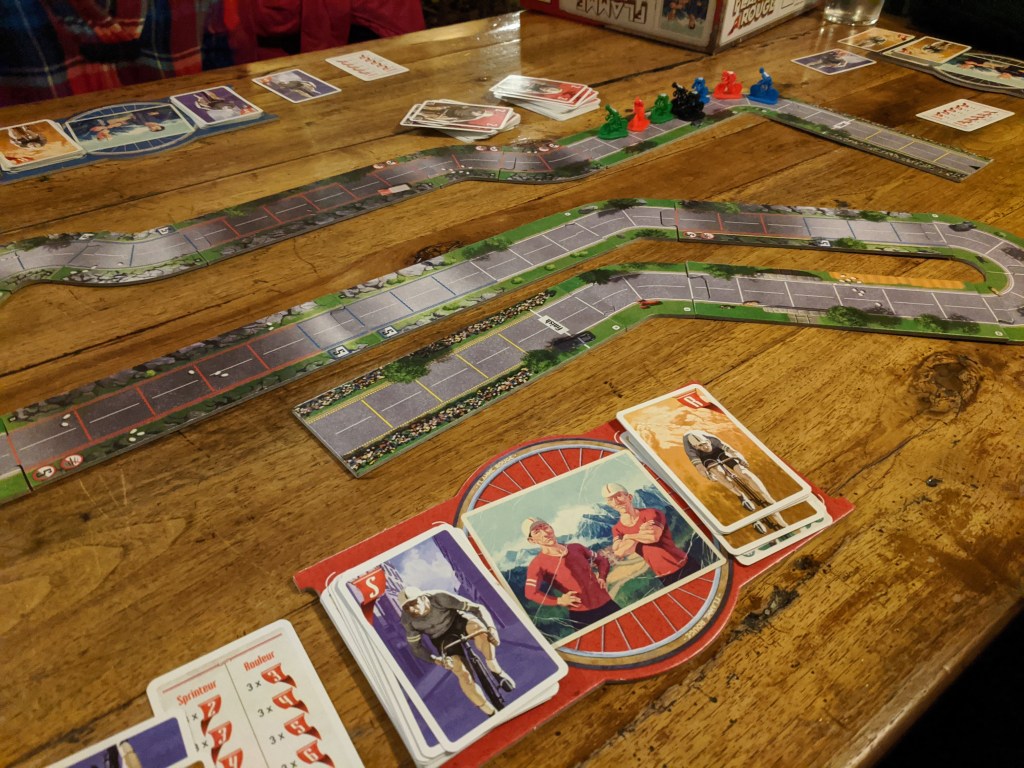
And they’re off! The cyclists are making their way around the track, all still in one pack. (This is a rare pre-Covid photograph from a board games meet up at the pub!)

During the final part of a round, the cards are discarded and some bonus effects are applied. Slipstreaming allows a pack of riders to move forward one space for free if there is a gap of just one space between them and the next pack. Interestingly, since this is applied from the back of the course to the front, it can be applied multiple times to the same rider!

Once slipstream effects have been applied, the riders at the front of each pack collect exhaustion cards as they battle against air resistance! These are shuffled into the rider’s deck and have a low movement value of two, which will no doubt annoyingly pop up during future rounds and limit your movement as your rider succumbs to exhaustion!

The rounds continue until a rider crosses the finish line.

If this were the situation after all movement cards have been played, then the Black ‘R’ (Rouleur) at the end of the pack would slipstream forward one space. Then the Blue ‘R’ and ‘S’ (Sprinteur) and the Red ‘R’ would also move forward one space as a group to join the front pack. The Black ‘S’ and Red ‘S’ would then each receive an exhaustion card.

Why play it?

There’s a fair amount of luck involved, but you still have enough control over your riders to think up some long-term game tactics. The slipstream and exhaustion mechanics do well at balancing the game to ensure that the group generally stays together, but it’s not impossible to take a risk and go it alone with a rider, ploughing ahead and hoping nobody will catch you up! Unfortunately, on the flip side, if a lone rider falls behind, catching up with the rest of the group can quickly become a nightmare!

The different course layouts add to the replayability. As well as different bends, some have more or longer slopes, making the race more unpredictable. When travelling uphill, riders no longer benefit from slipstreaming and their movement is capped at five, no matter what value card was played. Conversely, on a downhill slope, all rider cards will be raised to a minimum value of five, opening up new opportunities to get to the front of the pack!

No matter how you play your cards, things always become tense at the last couple of corners as riders approach the finish line, with all players hoping to avoid exhaustion cards and draw a large number to take them over the line!

Verdict?

The simple rules and appealing artwork make Flamme Rouge an easy game to get into. Once you start playing, you’ll find it a lot of fun and quite competitive, yet strangely much more relaxing than you’d expect a Tour de France style race to be! A really lovely game.

The Mind

2 – 4 players and 15 mins.

The four of you stare at the card placed at the centre of the table: number 27. Each of you only has a handful of cards dealt from a deck of 100, and you hold number 29 – surely the next highest card the group has been dealt. Your teammates exchange silent glances, and you find yourself holding the gaze of the player opposite you, who also looks confident – but it’s still unlikely their card is a closer match.

 You’ve made your decision – with bated breath, you quickly reach out and place the card face up on top of the pile at the centre of the table.

Your teammate shakes their head. They slowly reveal the number 28 from their hand – game over.

How do you win?

Each member of the team is dealt a hand of cards. The team must lay all the cards in ascending order to complete the current level. Complete the final level to win the game.

How do you play?

The game deck contains cards numbered 1 to 100 and a separate deck of levels between 1 and 12. In this cooperative game, you and your teammates must lay your numbered cards in ascending order, but there’s a catch – you’re not allowed to communicate in any form. Sounds odd – but it does work, believe us!

The game begins at level 1, with each player receiving one card. Players signal they are ready by placing a hand at the centre of the table. Once everyone has given the signal, the fun can begin! In silence, players can place a card face up at the centre of the table at any moment they wish. They must place one card at a time, starting with the lowest number and ending with the highest. If all cards are placed in the correct order, then the level has been completed successfully – move on to the next level, shuffle all the numbered cards and deal out the same number as your new level.

At any point, a player may shout ‘Stop!’ to suspend play, which only resumes when all players have once again placed a hand at the centre of the table. This can allow players to gather their thoughts and regain some control if their teammates get caught up in a hectic moment of play!

A three-player game set up: One card to each player, with a ‘level 1’ card and the game deck in the middle. The team has three lives and one special throwing star card.

As tough as this game sounds, there is some help at hand. The team has some ‘life’ cards to protect them. If a card is placed in the wrong order, the game is halted and the team lose a life card. Any cards lower than the incorrectly placed card are removed from the game, then play continues. A special ‘throwing star’ card can be played at any time, but only if all players agree to do so by raising a hand. When played, the card allows each player to discard the lowest card in their hand. More of these cards can be earned as a reward as your team makes their way through the levels.

Once the final level in the stack is completed, you have won the game! Alternatively, losing your final life ends in failure.

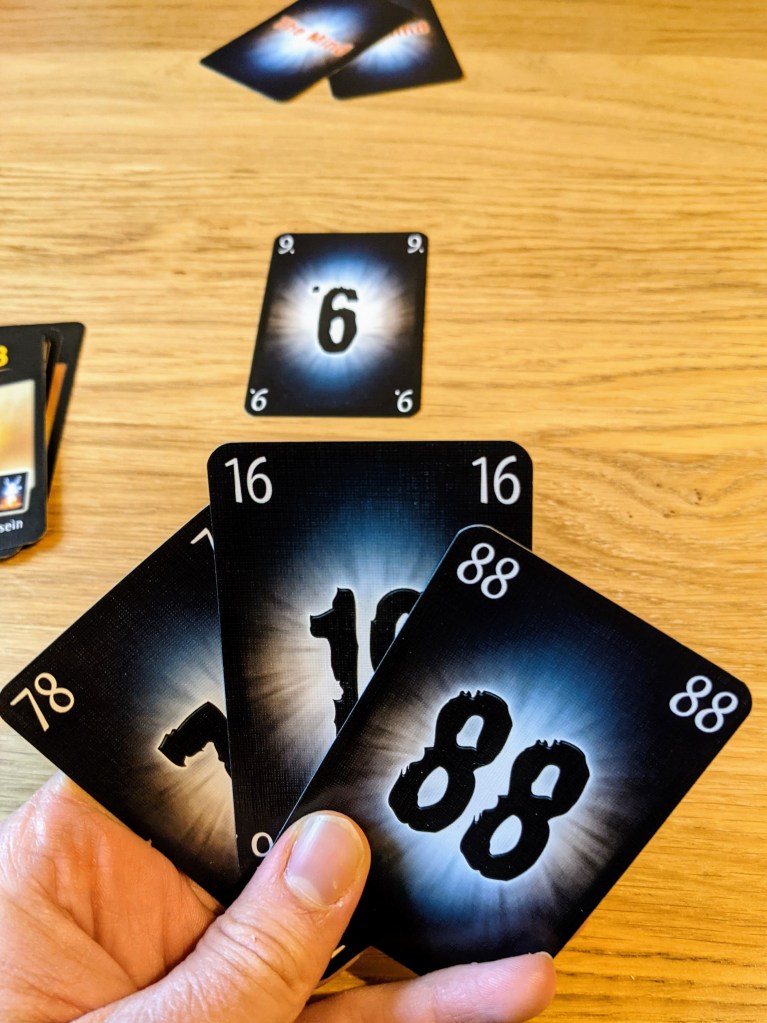
A hand of three cards. Would you be confident that 16 is the next higher card than 9, or might one of your teammates have a card between 9 and 16?

Why play it?

At first glance, this simple game seems absolutely barmy and quite impossible to win. After a first playthrough, we can guarantee that things will seem as barmy as you expected, with a lot of laughter and confusion in store. The no communication rule includes any sort of speaking, hand signals or writing – you’ll just have to trust the judgements of the group and people’s instincts!

Each time the group plays a round, you’ll be amazed that somehow you’re able to progress through the numbers with fewer and fewer mistakes, as you discover the mysteries of the game for yourselves – we won’t spill any secrets here though!

Verdict?

It’s a short and unique game that is a lot of fun to work out as you play with friends and best played with the largest team possible, which is four players.
Lost Cities

2 players and 10–30 mins.

Your last expedition was a roaring success and now you are keen to begin another. You have enough funds and the right contacts to begin another trip where an even greater reward is on the cards.

Great fame and fortune are almost certainly guaranteed, so long as a little luck is on your side! Oh, and if your opponent doesn’t beat you to it, of course!

How do you win?

Lay cards to form an expedition route and score points accordingly. The player with the most points at the end of a game wins.

How do you play?

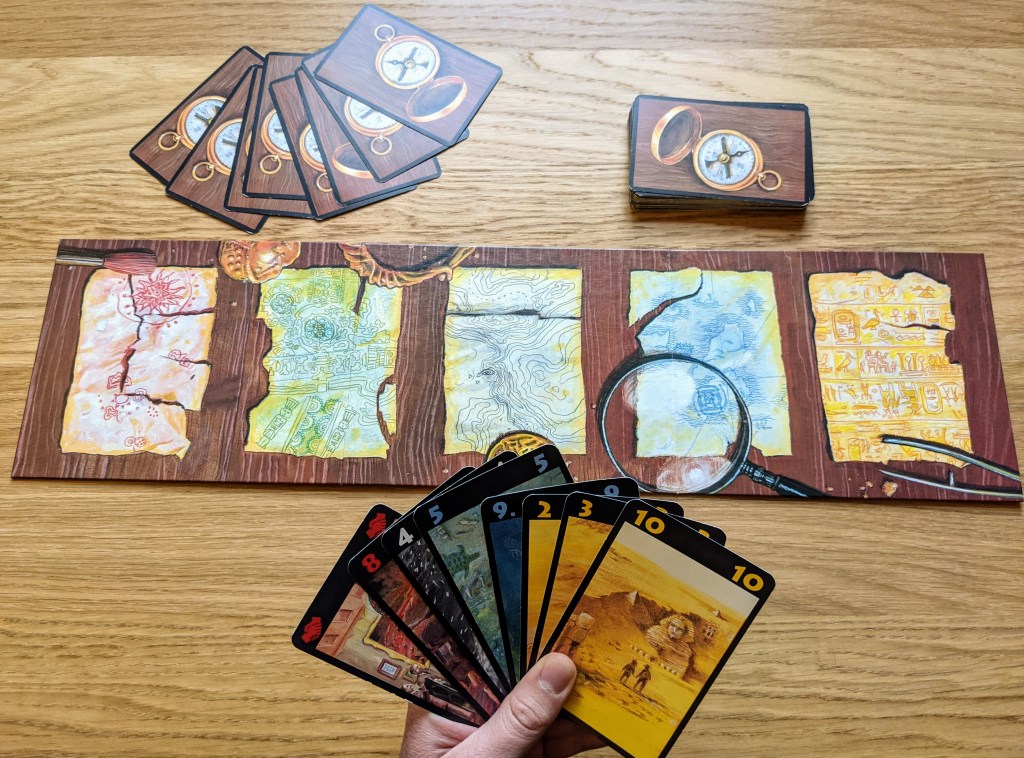
The deck contains one set of cards numbered 1 to 10 for each of the five colours. Each colour represents an exotic land and the cards you lay indicate your expeditions to explore them. Between each player is the game board, which will be home to the discard piles for the five card colours.

Game board in the middle and eight cards to each player – ready to start!

Each player will always hold eight cards. On your turn you must either commit to laying a card from your hand face-up on your side of the board (which amounts to setting out on or continuing an expedition) or discard a card from your hand, placing it face-up on the central discard pile of the corresponding colour. You then draw a new card to end your turn, either from the deck or by taking any of the top-most cards in the discard piles (excluding any cards you have just discarded). And it’s as simple as that, really; play alternates between the players until the last card is drawn from the deck, when the game ends immediately.

Your ‘expeditions’ are laid in columns of the same colour. Any new cards you lay have to be a higher value than the topmost card in that column. Remember, each card is unique – if you’re waiting for the elusive yellow six, it’s either in the draw deck or your opponent’s hand!

Play is underway and each player has started to place cards in ascending order on their side of the board. Some cards have been discarded on the central board

Each set of cards also includes several ‘wager’ cards, which feature a handshake symbol. Although these cards aren’t worth points on their own, they will double, triple or quadruple the value of the cards that are laid on top of them, depending on how many of the three wager cards were placed in the column. They must be laid before any numbered cards, hence the ‘wager’ aspect. Be careful though – a low-scoring column can end up in negative points!

Scoring at the end of the game can seem the most difficult part of your expedition, but it actually consists of just four steps. Begin by subtracting 20 points for each column that has cards placed in it – this covers the initial cost of your expeditions. Then, for each colour, tot up the values of the cards you have placed in that column. Take your total and apply the multiplication effect of any wager cards laid in the column. You then receive an additional 20-point bonus for each column which has eight or more cards in it.

The player with the highest score over three rounds wins (but we also play to just the one round!).

EXAMPLE SCORING: (-20+8+7+6)x3 from the red column, (-20+10+8+7) from the green column, 0 from white, (-20+9+8+5+2)x2 from blue and (-20+10+3+2) from yellow. This gives a total score of (3 + 5 + 0 + 8 – 5) = 11

Why play it?

The game generally feels well balanced with an equal mix of both tactics and luck; you’ll feel like every card you lay comes with both a cost and a benefit.

An ideal opening hand would have higher numbers all in one colour, which will guarantee that an expedition in that colour will pay off. Unfortunately, more often than not, you’ll have a mix of different colours and values, leaving you feeling like you want to keep your whole hand! It’s up to you to gamble on which colour to discard, which to commit an expedition to and which colour to keep from you opponent’s hand.

You may fancy your chances in a certain colour and lay a wager card from your hand, perhaps hoping to pick up some useful cards from the deck. Then be prepared for your heart to sink as your opponent lays the most valuable cards of the same colour on their side of the board, sealing your fate to a large negative score!

Inevitably, while you’re still hoarding the high-value cards and calculating whether you have enough time to start a new expedition, you’ll suddenly notice the draw deck is starting to run low and time is running out. In desperation, you will then try to get all your cards out in a total panic before the game ends, while your opponent does their best to run the clock down of course!

Verdict?

Don’t be put off by the mathsy scoring; this game only sets a couple of rules, but gives you many different ways to approach your turn and the simple, balanced gameplay doesn’t feel repetitive at all. A nifty little two-player game packed with more tactics than you expect.

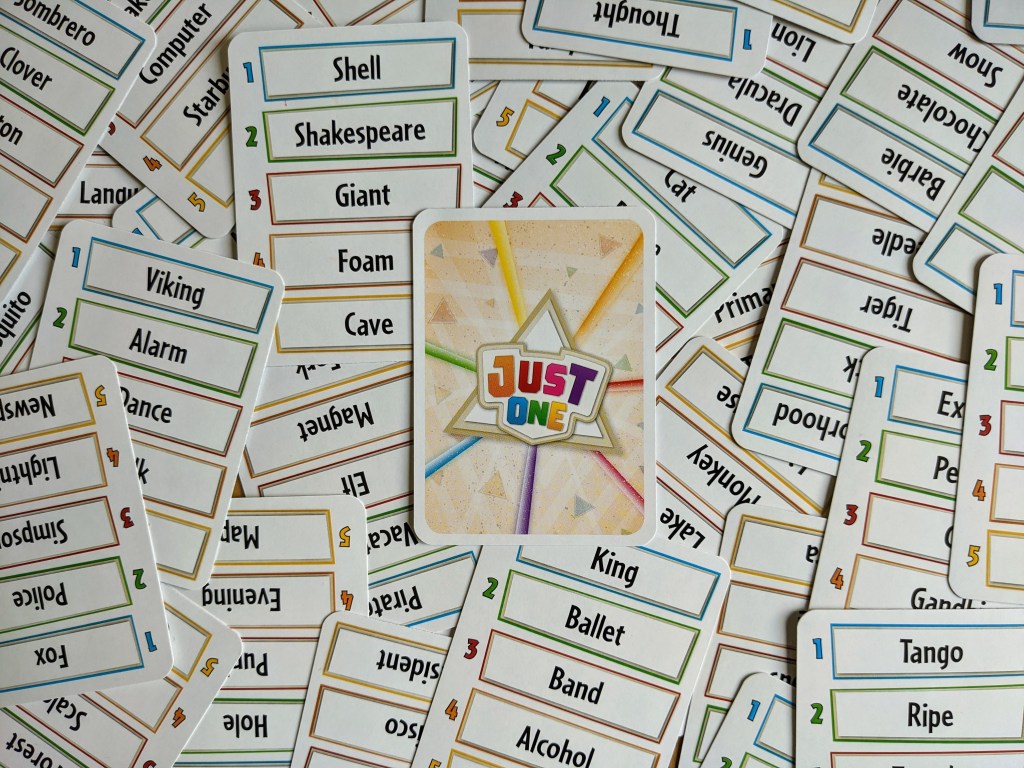
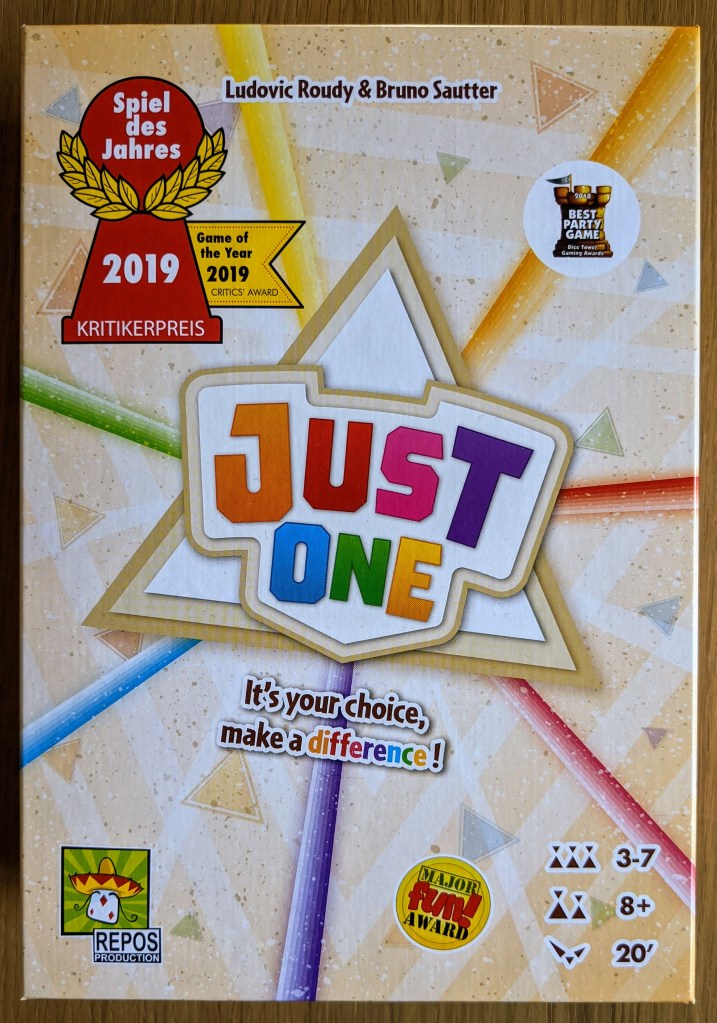
Just One

3-7 players and 10-30 mins.

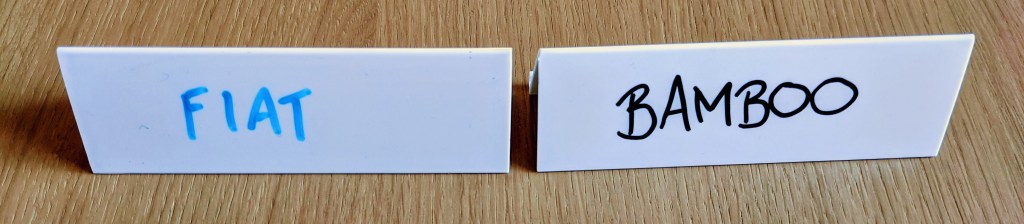
You open your eyes. The words in front of you are ‘FIAT’ and ‘BAMBOO’. What word links these?

Is it latin? Something to do with cars? Species of plants? Perhaps a more obvious clue would have helped…

How do you win?

Correctly guess the Mystery Word on your card using the clue words given by your teammates.

How do you play?

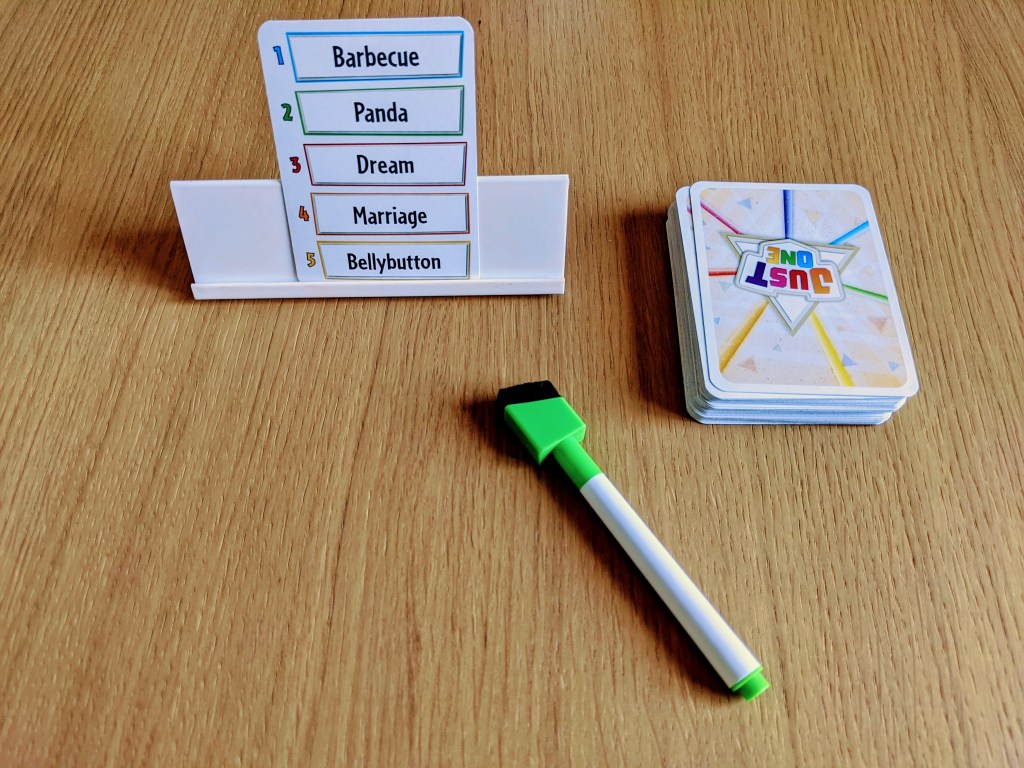
The active player draws a card and, without looking at it, picks a number between one and five, indicating the Mystery Word they have chosen. The other players are shown the list of five words on the card. Each player must think of a one-word clue to the chosen Mystery Word and write it on their mini whiteboard.

This card has been selected and the number 2 chosen. The players must provide a one-word clue to identify the word ‘Panda’ to the active player. By the way, the board pens are good quality and have a handy rubber on their lid (with some games, we’ve noticed the pens dry out so quickly!)

The players must not communicate while brainstorming their clue words. A few rules also apply to the clue words; players can’t just write the Mystery Word in a different language, or spelt oddly. You cannot invent fake words, use words which contain a part of the Mystery Word or use words which are phonetically identical, even if the meaning is different. So for a Mystery Word of ‘Panda’ you couldn’t have a clue word of ‘Pander,’ and for ‘Actor’ you couldn’t use ‘Actress’ or ‘Hollywooding.’

The four players have written their clues and the words are compared.

Once all players have a clue word prepared, the active player looks away while the others compare their clues. If any players have written the same clue, then each of them must rub out their clue. The active player then opens their eyes – hoping to see a full house of clues –  and tries to guess the Mystery Word from the clue words in front of them. The player only has one guess – the pressure’s on!

When the active player opens their eyes, they will only see these two words, since both of the boards with the word ‘Bear’ have been removed. Would you have been able to guess the Mystery Word, or would you have taken a lucky guess?

The active player role then moves clockwise.

Why play it?

Just One is a fun co-op party game that packs a lot of punch for such a simple set of rules. Like other word-based games, the replayability comes from the English language rather than a fat rule book! It’s a great game to bring out to convince the uninitiated that there is more to the board game universe than just a tediously long game of Monopoly.

There is a lot of fun in devising a clue word. You’ll be carefully treading the line between taking a gamble on an obvious clue – one that’s so obvious your neighbour may well go for it too – and opting for an ingenious niche word; a tactic that may pay off if it’s accompanied by more run-of-the-mill clue words, but may lead the active player astray if they aren’t on the same wavelength.

Guessing the mystery word as the active player can actually get quite tricky, but it is achievable. Remember that, as you haven’t seen the list of words, the clues must guide your thinking – which can be a problem when only one whiteboard makes the cut! This will be when your educated guesses become more of a stab in the dark…

If you are keen, there is a more detailed scorekeeping mechanic, but we usually find it a bit unnecessary, with enough enjoyment to be had from just playing the game for the fun of it. Perfect for a quick 10 minutes between longer games or a little longer after a dinner party.

Verdict?

It’s one of those unique games that’s so simple you feel like it must have been around for ages, or you wonder why you didn’t come up with it yourself – but it was only created in 2018!

An excellent co-op word game to bring along to larger groups that should keep everyone entertained.

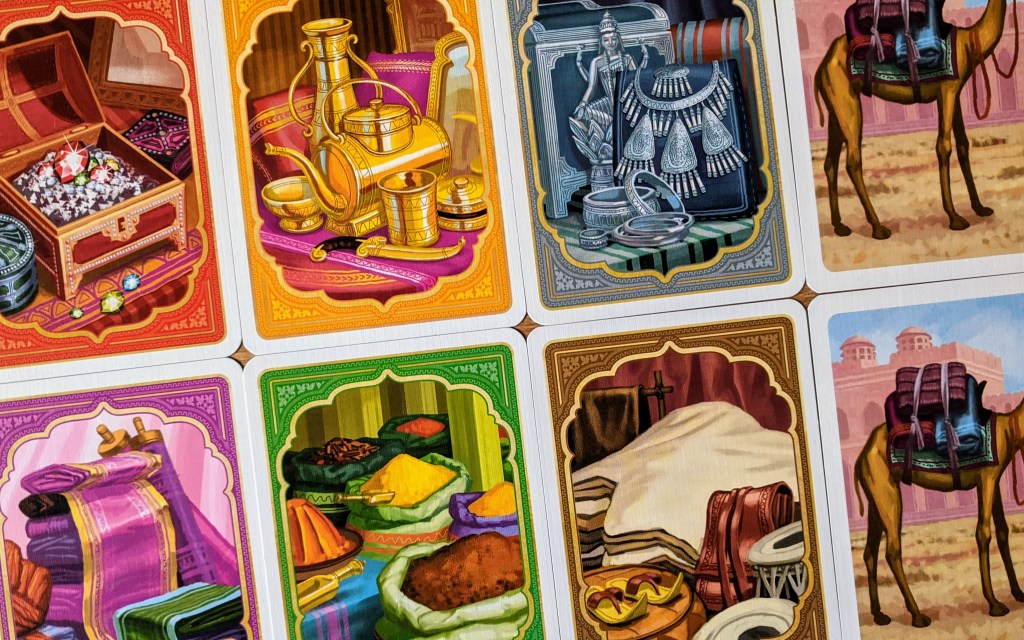
Jaipur

2 players and 25 mins.

Welcome to the city of Jaipur! You enter one of the Pink City’s bustling markets and begin to explore. The true object of your search lies amongst the bright colours, fragrant spices and precious gems– the chance to cut a deal, collect the most rupees and become the Maharaja’s personal trader.

How do you win?

Sell goods to claim rupee tokens; the player with the most rupees at the end of a round wins a Seal of Excellence token. Collect two of these tokens, and you win the game.

How do you play?

The deck includes two kinds of card: camel cards and coloured cards representing six different goods to trade at the market, namely leather (brown), spice (green) and cloth (purple), and then the more valuable silver, gold and diamonds. Camel cards are a little different to the goods cards; rather than being kept in your hand, they are placed in a pile in front of you as your herd. Conveniently, they do not count towards your seven-card hand limit, but can still be used to buy goods throughout the game – and the player with the biggest herd at the end of the round is awarded a five-rupee bonus.

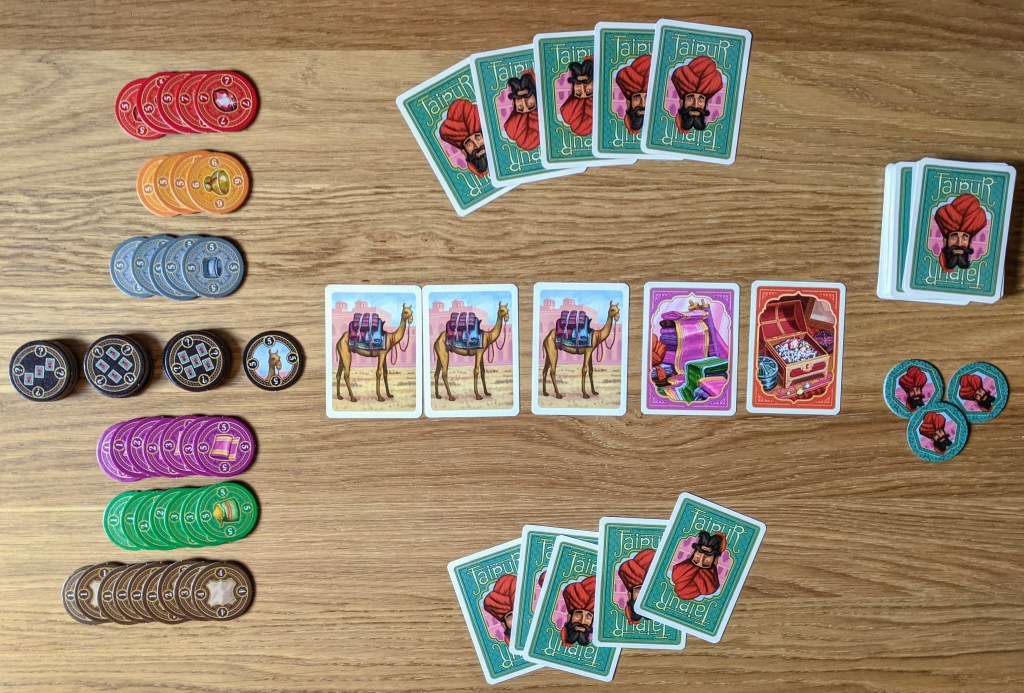
A ‘marketplace’ is set up between the two players, with five cards always on display. To the left of the marketplace are the rupee tokens that can be claimed by selling your wares. Some rupee tokens are more valuable than others, even if they are the same colour – these are always at the top of the pile, available to the early-bird seller.

A starting set-up. Rupee tokens on the left from the cheapest goods (leather) at the bottom, to the most expensive (diamonds) at the top. The colours match the goods cards. The coveted ‘Seal of Excellence’ tokens are below the deck on the right.

When it is your turn, you may either take cards or sell goods.

Taking involves either:

  • exchanging cards (camels from your herd or goods from your hand) for an equal number of goods cards on display at the marketplace in the middle;
  • taking one card on display at the market;
  • or taking all the camel cards from the market and adding them to your herd.

Selling means discarding at least one goods card from your hand in exchange for the equivalent number of rupee tokens. You can only sell one type of product on your turn, but you can sell as many of that product as you like. If you sell three or more cards in one go, then you also collect the appropriate bonus token; the more goods cards you sell at once, the higher the bonus. Note that when selling the most valuable items (silver, gold or diamonds) you must sell a minimum of two cards.

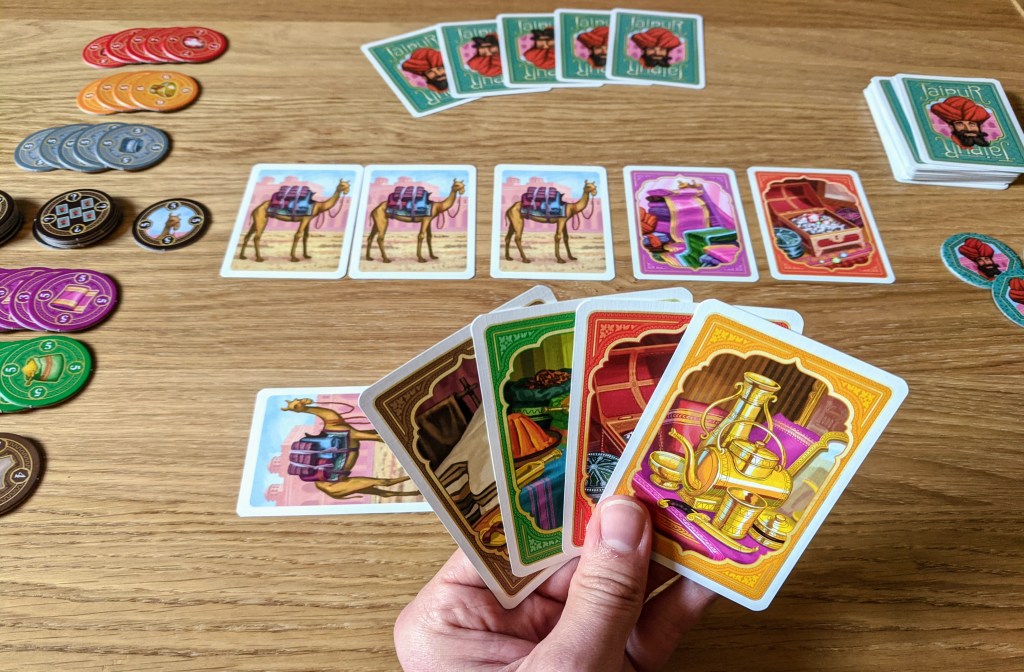
Your starting hand. The camel you drew is placed face up to create your herd. If you choose to take, you could either claim the three camels from the marketplace or pick up the diamond or cloth from the marketplace. If you sell, you could discard the leather or spice in exchange for the matching rupee token.

Play alternates between each player, with each either taking or selling cards. The round will end as soon as three types of goods tokens are sold out or there are no cards left to draw for the marketplace, and players then score up all their rupee tokens.

Why play it?

This game is absolutely excellent in that it is as engaging as other games designed for more than two players.  With such a large choice of actions and tactics, the game feels much more open-ended than the traditional battle of logic or luck in other two-player games.
There are several ways to score big points, such as focusing on valuable goods, collecting bonus tokens or being the first to trade. On this last point, our advice would be: sell fast! There is a lot to be said for selling early to grab the high-priced tokens, so keep an eye on which goods your opponent is collecting and try to beat them to the first few most valuable tokens. You’ll gain some quick points (and maybe cause some annoyance!), while denying your opponent the highest-scoring rupees.

Although bonus cards can also lead to rupee riches, be mindful that if you hold out for the larger sale bonus of four or five cards, this can cause you to miss a quick sale (and thus cost you the valuable first sale tokens), while also clogging up your hand, which is governed by the seven-card limit.

The game is nicely balanced, so if your opponent liberates the marketplace of a valuable card you desperately wanted, you will at least get first choice on the new item dealt to the marketplace, which, if luck is on your side, could be that diamond card you’ve been waiting for. Similarly, taking a large herd of camels from the market effectively refreshes the marketplace for your opponent, giving them a large choice of new goods, yet your new large herd gives you a lot of flexibility throughout the game.

Verdict?

Probably our favourite two-player game yet. A lively and fun trading game where you occasionally feel like you are collaborating with your opponent, until it becomes apparent that you are after the same goods! We sometimes play just one round for a quick 10-minute game, but then usually end up playing best of three!

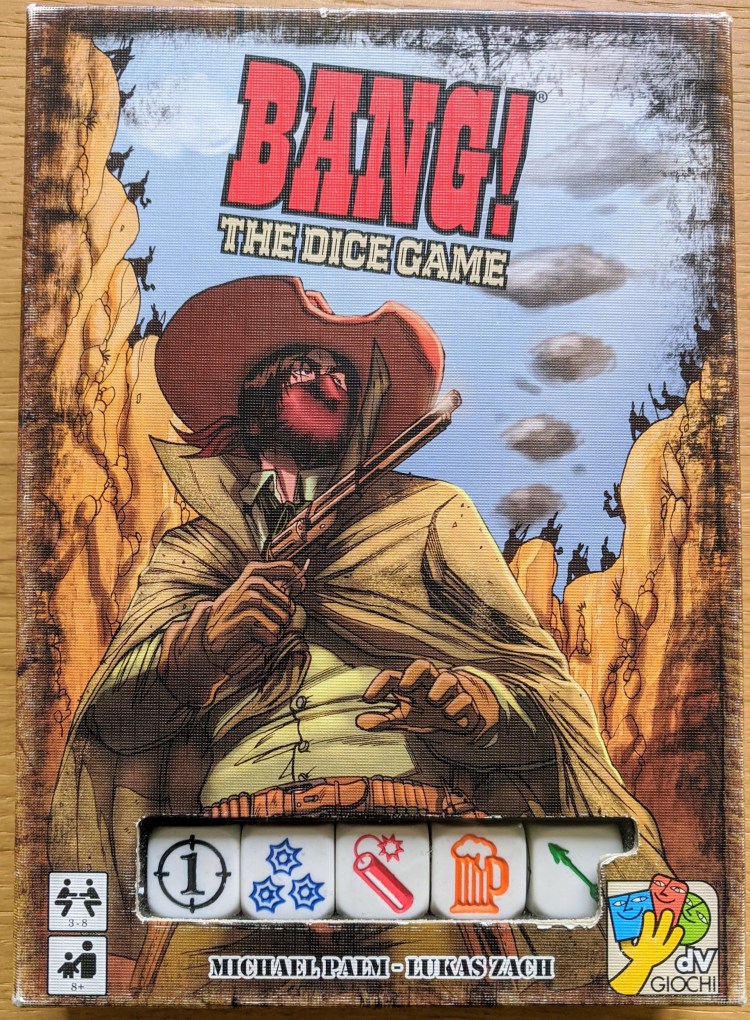
Bang! The Dice Game

3–8 players and 15 mins.

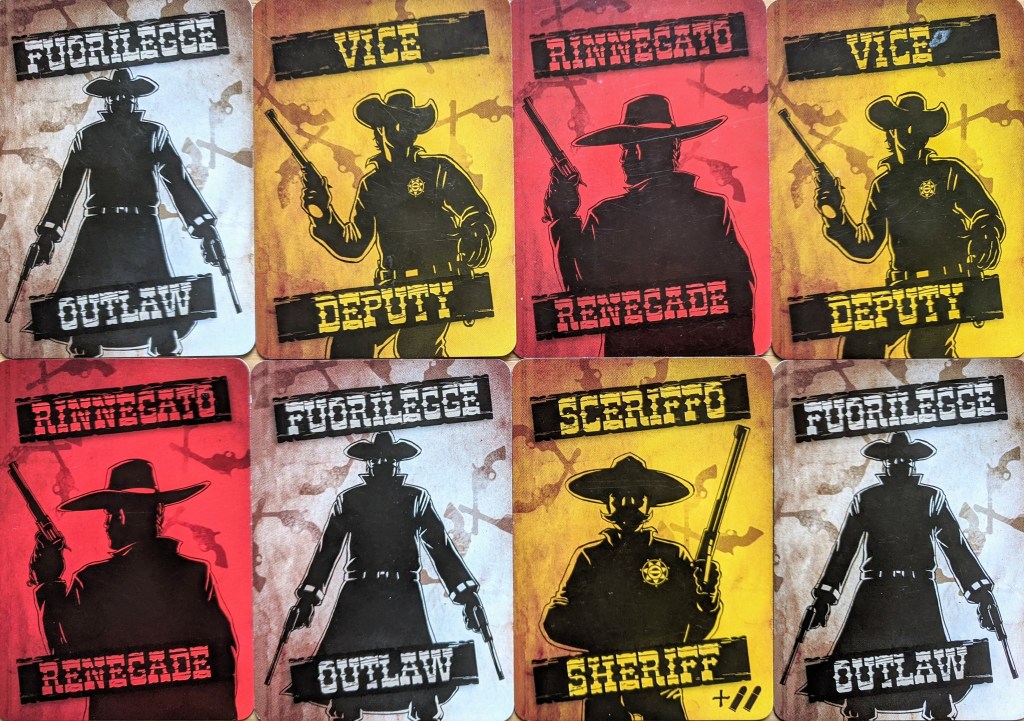
Take on a gunslinging cowboy role in this Spaghetti-Western style game. Will you emerge the lone Renegade or will the Sheriff round up all the Outlaws and bring order to the wild west?

How do you win?

The Outlaws want to take out the Sheriff and win the game the moment they do so. As the Sheriff, your aim is to rid your town of all Outlaws, while the Sheriff’s Deputies need to protect their boss and eliminate any threats. Meanwhile, the Renegade wants to be the last player standing.

How do you play?

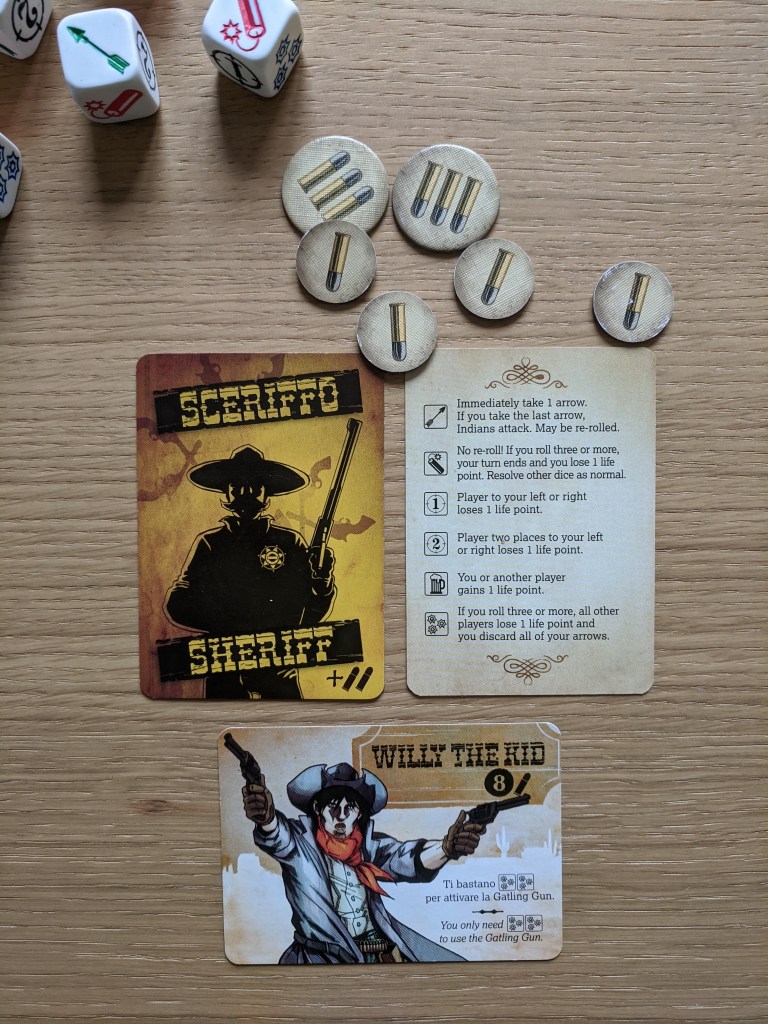
Collect your secret identity card, a character card and the number of ‘health’ bullets shown on the card. The Sheriff reveals their secret identity card and collects a couple of extra health bullets, which will come in handy since they are most likely to attract some pot-shots!

Your starting hand – this player is the Sheriff, so their secret identity card is revealed. To the right is the handy reminder card, which details the possible dice rolls and the order in which dice are resolved

During a turn, you roll the five dice, each of which has five symbols. After your first roll, you get up to two further rerolls for each dice, putting aside any dice you like the look of each time. Rolling a ‘1’ or ‘2’ allows you to deal –1 damage to a player sat ‘1’ or ‘2’ places either side of you, causing that player to lose a health bullet. If you roll a beer symbol, you or a player of your choice can heal +1 health, gaining an extra bullet.

Rolling is not without risk though, and it comes in the form of arrows or dynamite. An arrow dice means taking an arrow card from the central pile, which is not too much of a problem until the last arrow card is dealt. This signals an attack from the Indians, meaning that all players must discard a health bullet for each arrow card they hold, and remember, no health bullets means you are out of the game! Dynamite is nothing to worry about unless you roll three at once, which ends your turn immediately and costs you a health bullet.

The final symbol is a ‘gattling gun’, which only activates if it appears on three or more dice at once. You then remove all arrow cards on your character and deal one damage to every other player. The dice are resolved in a particular order, so, for example you must take any arrow cards before the gatling gun takes effect.

Play continues clockwise, with each player rolling the dice and trying to pick off their enemies.

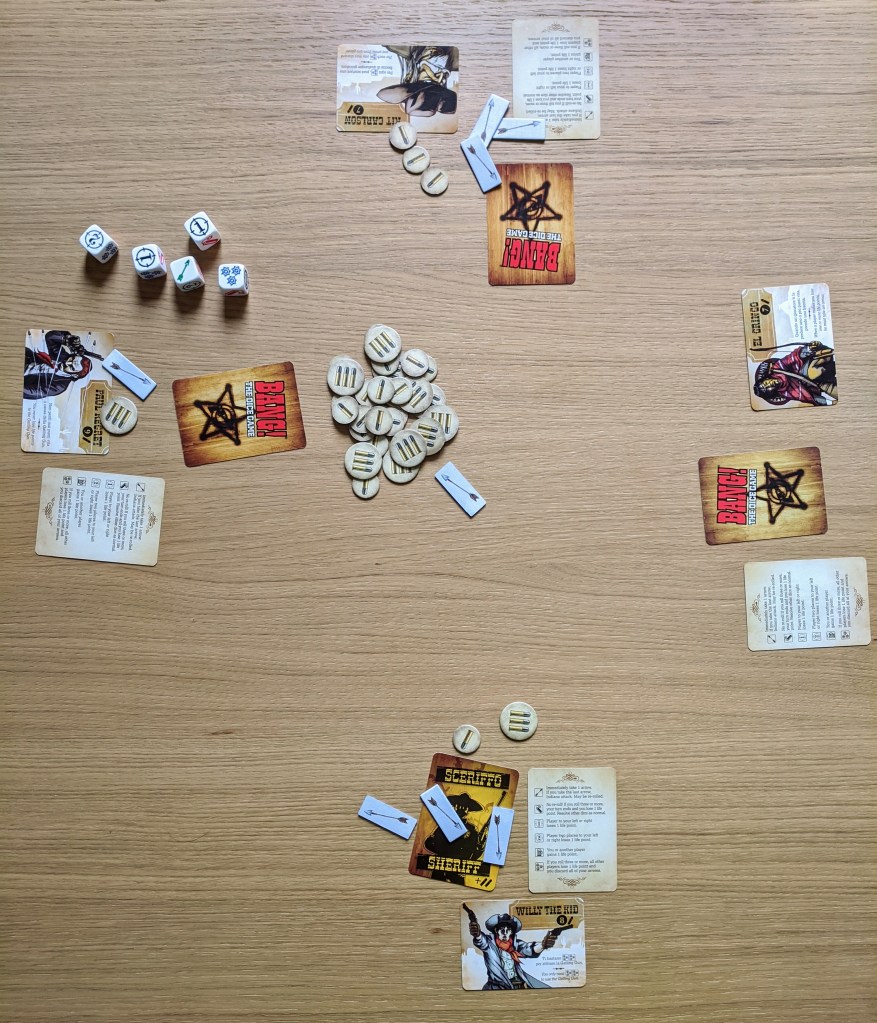
A four-player game is underway. The Outlaw on the right has been knocked out of the game (with no health bullets remaining), and this latest roll will mean that players must cash in their arrows cards in exchange for negative health points, killing the second outlaw at the top of the table. All that remains is a final dual between the Sheriff and the Renegade.

Why play it?

Although your identity card is secret, the motives of each player will quickly become apparent. Typically, Outlaws will claim to be the Deputy to avoid any initial attacks from the Sheriff, who is unlikely to be won over until they have received some refreshing beer from their ally (much like real-life friendships, perhaps?).

The roles are well balanced, with the Renegade having to carefully bide their time when it comes to attacking the Sheriff, since Bang! is the sort of game where a slew of players can be knocked out before their next turn comes around, and one unlucky role can spell disaster for a once-healthy player.

The arrows mechanic can lead to some amusing moments, as you are clearly living on borrowed time if your arrows outnumber your remaining health points. This may even encourage some opponents to collect an arrow or two in a bid to trigger the cashing-in of arrows! The order in which you resolve dice can also lead to some tense moments, with any rolled arrows or dynamite potentially knocking you out before you are able to use a beer.

As players are captured (Dead or Alive), the ‘1’ or ‘2’ rolls become more powerful, since you are able to target new opponents who were previously out of your range. This inevitably leads to a showdown at the end of a game, which is typically between two heavily injured foes.

Each player’s unique character card grants a special power, which helps to keep the game fresh and replayable, although some special powers are certainly more useful than others! Generally, the game feels better with five or more players, as this gives you the chance to form teams and alliances – though there is no guaranteeing that pacts won’t be short-lived!

Verdict?

A nice little filler between longer games, this is a good game to choose if you fancy something light and fast-paced, or if you want to exercise your ruthless side! Works best for larger groups, and although the game relies on luck a lot of the time, you just know you’ll come out on top the next time you play!

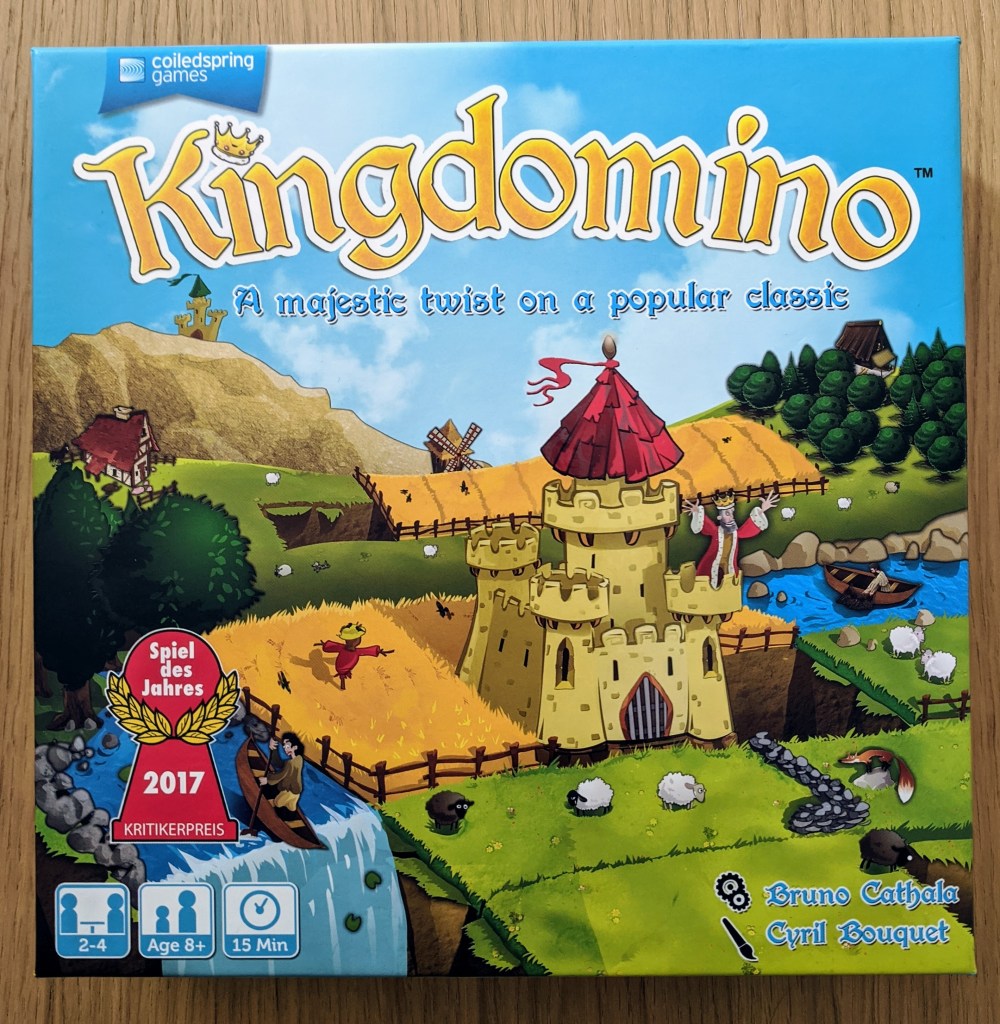
Kingdomino

2–4 players and 15 mins.

Place tiles around your castle to grow the lands within your kingdom. But be on your guard, as other kingdoms will also have their eye on the most valuable land!

How do you win?

Create the highest-scoring kingdom, as determined by the number of crowns and type of terrain in your domain.

How do you play?

Each player has a king and a castle of their colour. The aim is to build their kingdom using terrain tiles, which range from lush forests to deep oceans, and even include sticky swamplands! These terrain tiles are split into two halves, just like dominoes.

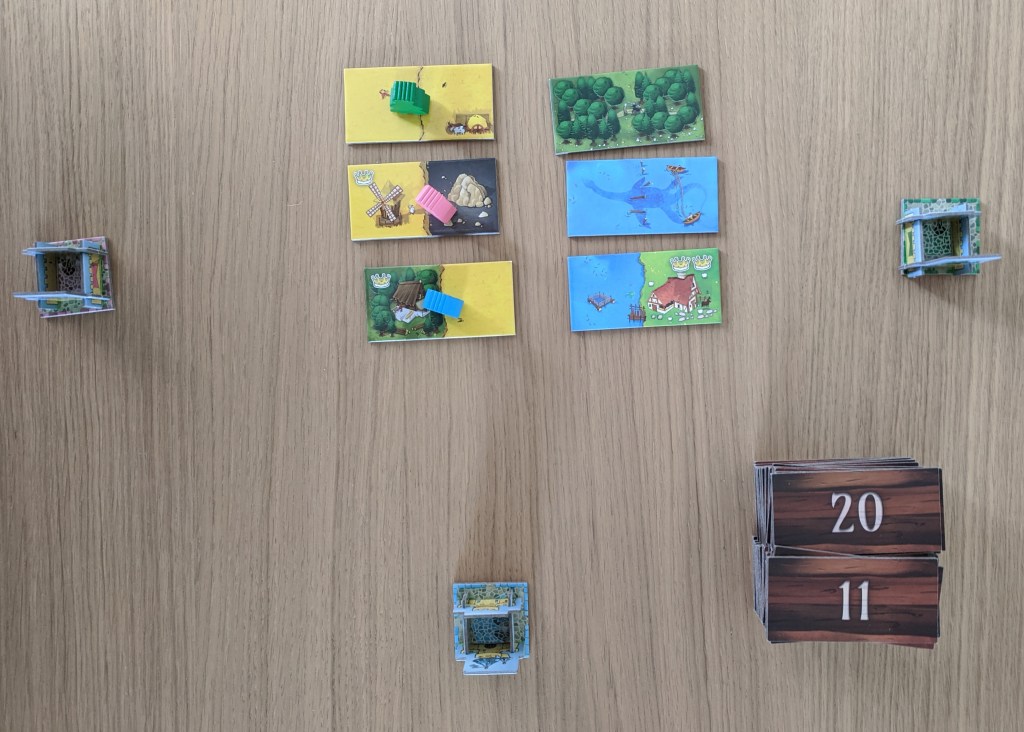
At the beginning of the game, two columns of terrain tiles are dealt, with each column containing tiles equal to the number of kings in play. On the back of each terrain tile is a number; the higher the number, the more valuable the tile is likely to be in terms of scoring. The lowest numbers are always placed at the top of the column and the highest at the bottom. For the first turn, the kings are placed randomly on the first column of terrain tiles, as below:

The start of a three-player game. Each castle is ready to collect tiles!

Play starts with whichever king is at the top of the column. This player adds the tile their king is on to their kingdom, then chooses a tile they like the look of from the new column by placing their king on that tile.

Play continues clockwise and once the last king is placed, then a new column of terrain tiles is dealt adjacent to the existing column. This process continues, with players choosing their next tile and building up their kingdom, until all tiles have been dealt.

Kingdom bureaucracy dictates that a claimed tile must connect with at least one terrain tile of the same type (again, think dominoes!), or with the castle tile. Your kingdom must also be built within a 5×5 grid – so you wouldn’t be able to create a long and thin empire – although your castle doesn’t have to be at the centre of this 5×5 grid.

If you aren’t able to place a terrain tile, either because it would extend beyond your 5×5 grid or because your kingdom doesn’t have a matching tile, then it is discarded.

By turn five, each player is starting to build up areas of the same terrain within their kingdom

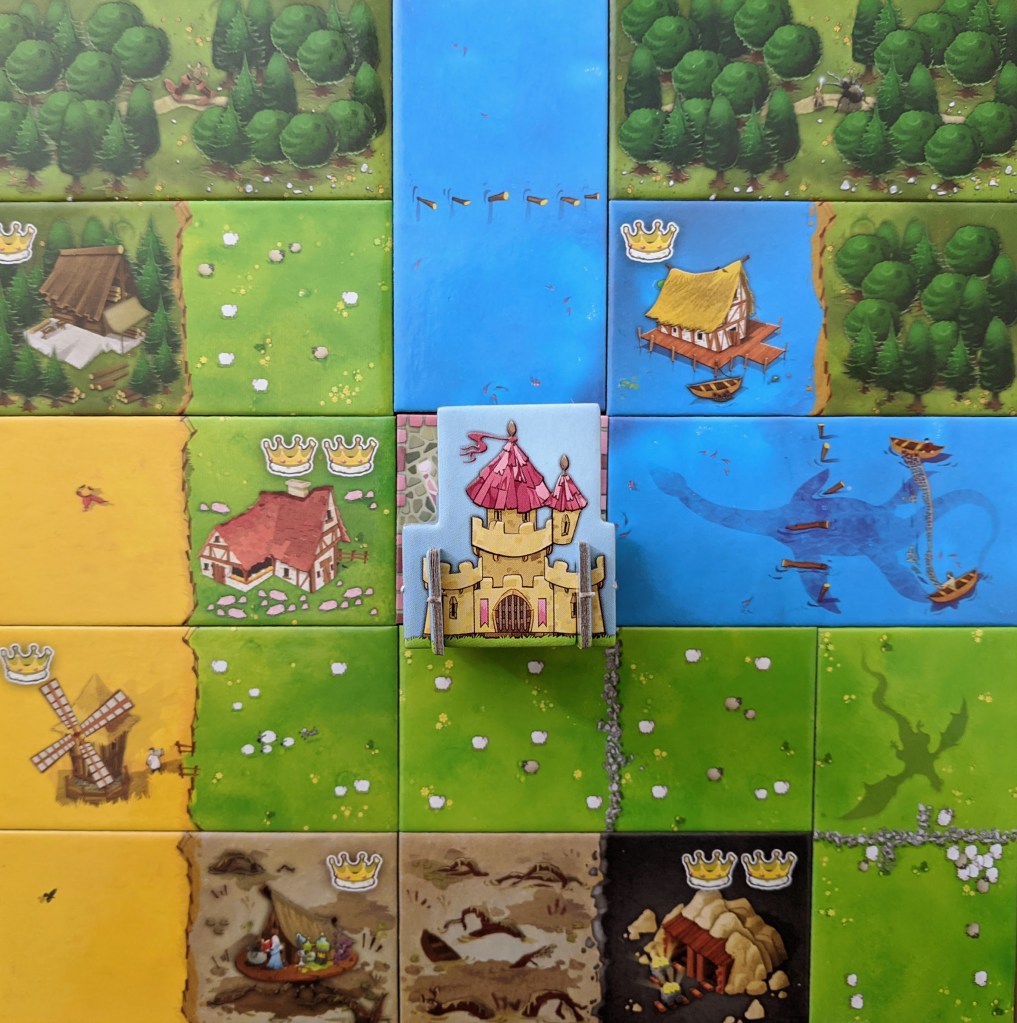
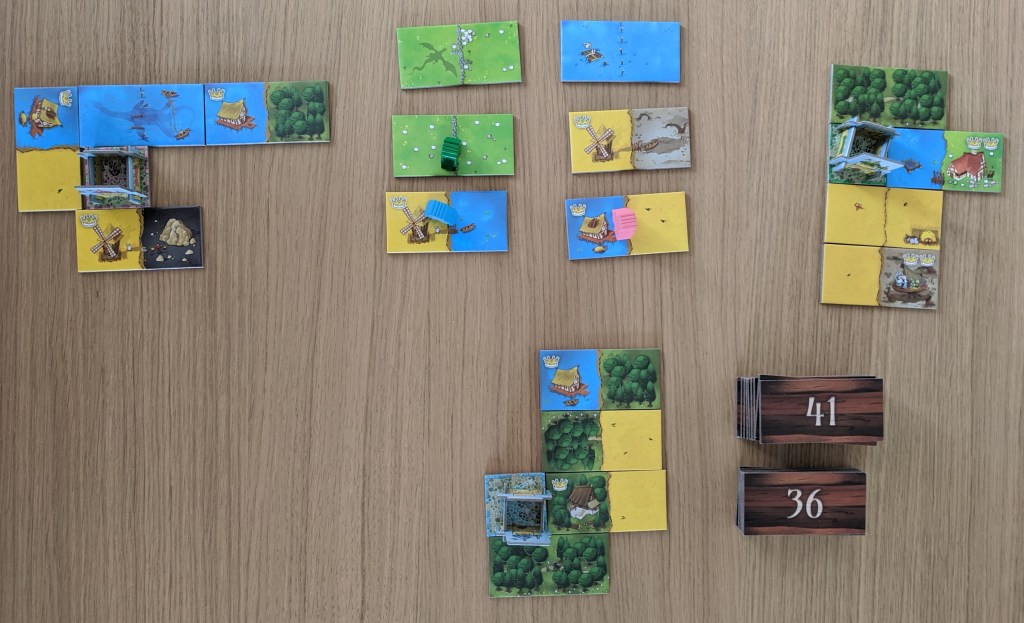
In order to score your completed kingdom, count the number of terrain tiles grouped together and multiply this by the number of crowns within the same area. Taking a look at the cover image above, the kingdom would be scored as below for a total of 29 points.

Why play it?

The highest scores will come from players who collect large areas of one type of terrain with enough crowns to score well, or those who go for the less common but ‘crown rich’ swampland and mine tiles. Of course, other players will be keen to stop you collecting quite so many crowns within your kingdom!

It’s important to note that whichever king starts the round at the top of a column has first choice of tiles in the next column. This means you may want to pick one of the less valuable tiles in order to be in pole position next time around. Conversely, if you pick a valuable tile at the lower end of a column, then you won’t be left with much choice during the next turn! As well as balancing the game, this mechanic keeps you interested and mixes things up round by round, avoiding that feeling of ‘waiting for your turn.’

A few optional rules add a little extra to the game, including the chance to bag bonus points if you keep your castle at the centre of your grid, or if you manage not to discard any tiles.

Kingdomino is also an excellent game for two players – there are no awkward ‘two-player variant’ rules, which can sometimes make a two-player version feel like an afterthought. In fact, with only two players, the game can get more intense since you each get two kings to place and collect two tiles per turn, which can require more foresight and strategy than a larger game.

Verdict?

A great game for your shelf that is easy to set up, Kingdomino is the perfect choice if you’re looking to play a few quick rounds of something. Super replayable and nicely balanced, an excellent choice for two players or more.

Zooloretto

2–5 players and 45 mins.

Fill your zoo with exotic animals to draw in the crowds and impress the punters. The zoo with the most animals will surely come out on top, unless your establishment happens to have a snack stand or two!

How do you win?

Choose one species for each enclosure of your zoo, filling the available spots in each one to earn points. The game ends when all the tiles have been dealt, and the player with the most points wins.

How do you play?

Each player begins with an empty zoo in front of them, consisting of a barn and three enclosures, ready to welcome their residents. In the centre of the table are empty delivery trucks, equal to the number of players. Each truck will deliver up to three animal tiles (or other special tiles) to each player’s zoo in each round.  
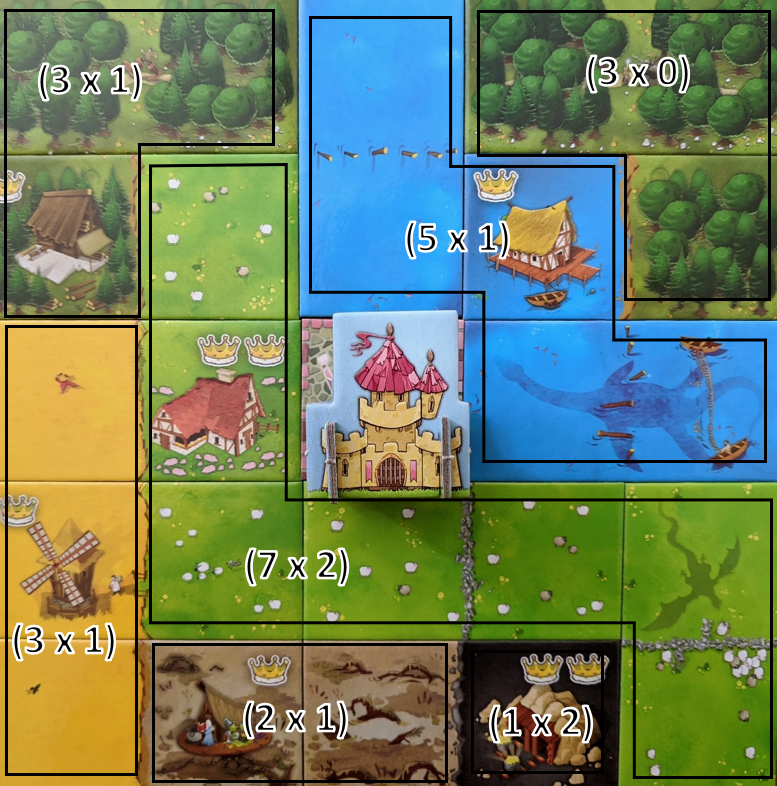
On their turn, a player decides to either to take a tile from the bag and place it on one of the trucks; take a delivery truck and claim its contents for their zoo, ending their participation in this round of the game; or carry out one money action. Play then continues clockwise, with the next player selecting one of these actions. Once the last truck has been claimed by a player and its contents unloaded, the round is over and the empty trucks are placed back in the middle of the table, ready for the next round of deliveries.
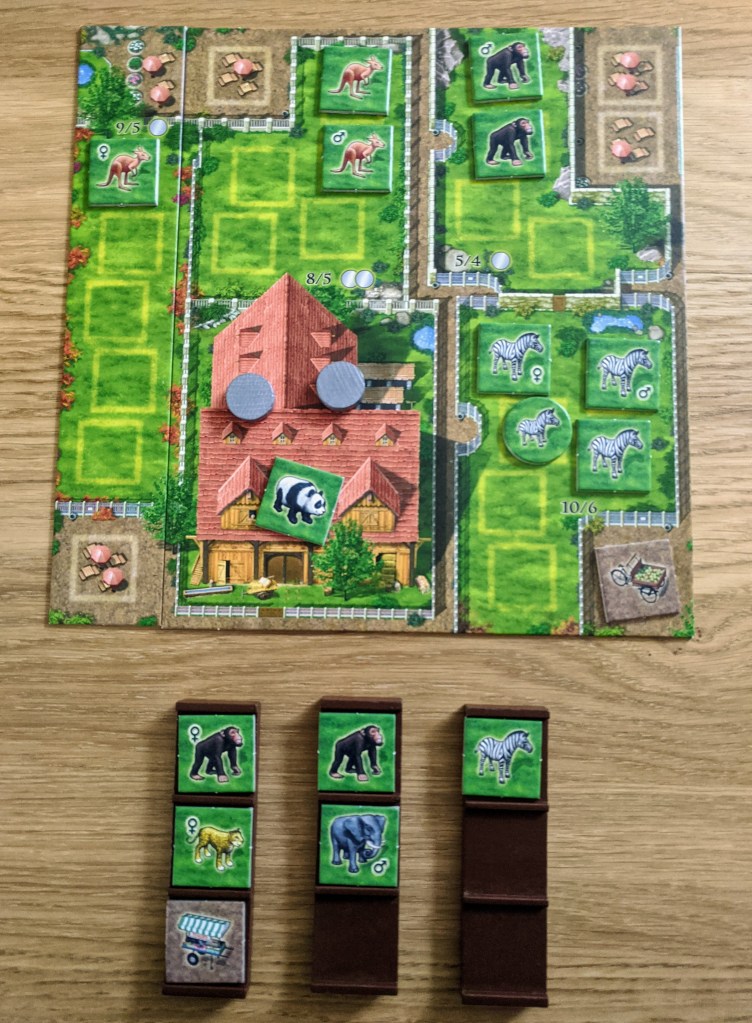
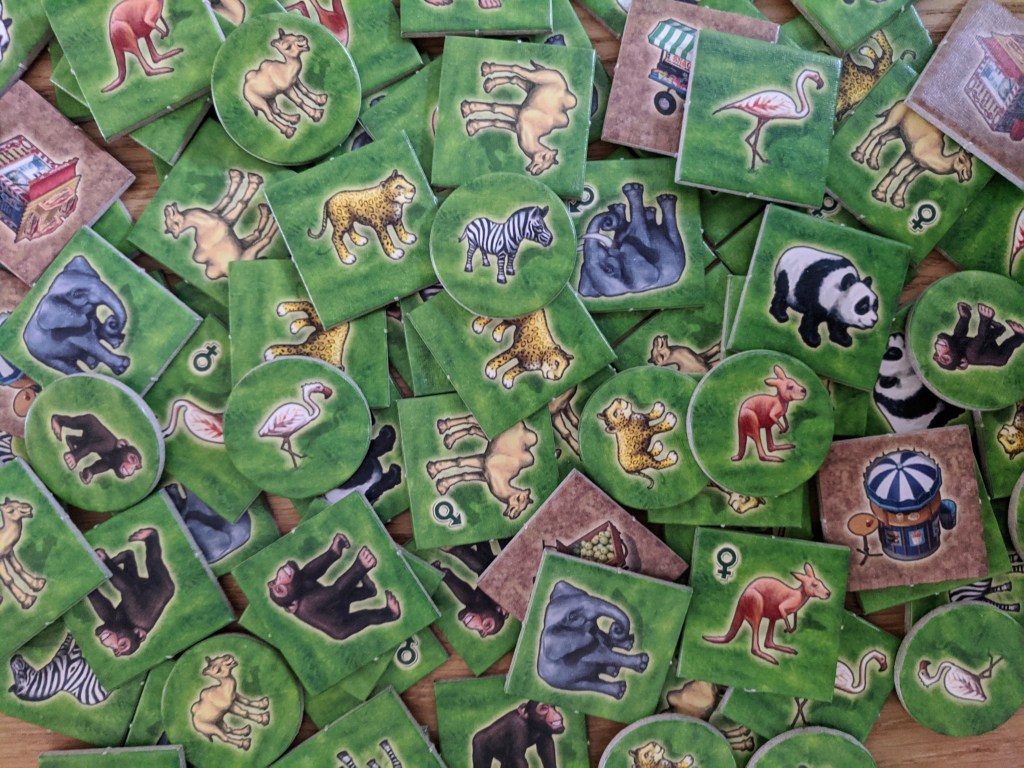
The game tiles include eight species of animal, such as gorillas, flamingos, pandas and chimpanzees. Players score points by filling all the available spaces in a zoo enclosure, or by leaving only one space unoccupied (although this is less lucrative). The animals are fussy and so different species cannot be mixed within an enclosure, and any animals that don’t fit in your enclosures must be stored in your barn. Watch out though, since any animals left in the barn at the end of the game will be worth negative points!

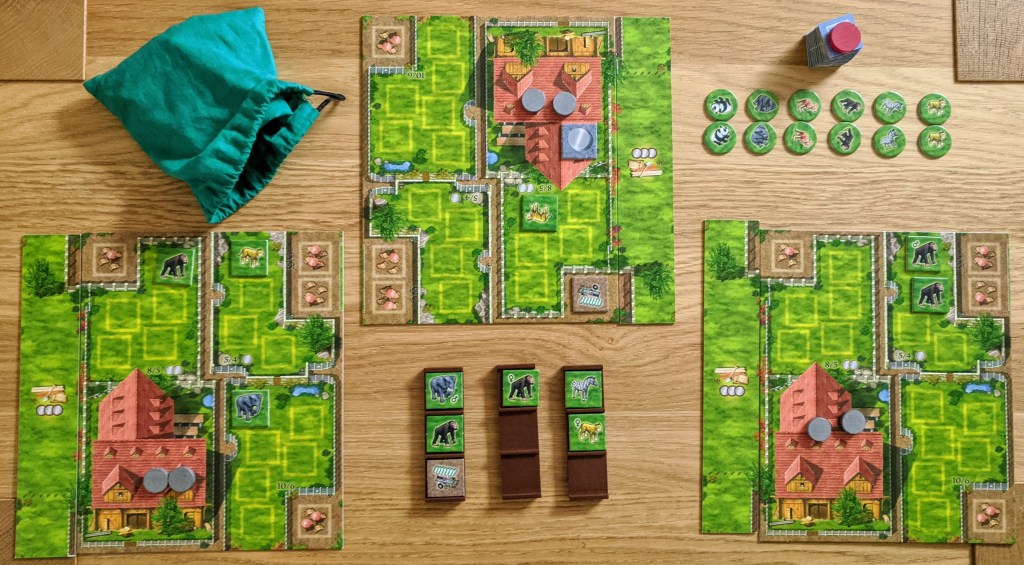
A couple of turns into a 3-player game and the three trucks are filling up with tiles! Each player’s zoo is still quite empty so they will probably be open to taking the full truck, or they may choose to add some more tiles to the others first!

The delivery trucks can bring other benefits for your business in the form of snack stalls and coins. Snack stalls give you victory points – although only two per type (species?) of stand – and they can boost your points in enclosures that aren’t at capacity and would otherwise score zero. You can use coins to help out your zoo in a variety of ways, such as purchasing a new enclosure, paying to discard an unwanted tile from your barn, or purchasing an animal tile from another player’s barn. You can also pay to move or swap sets of tiles between your barn and enclosures.

Notice the round tiles with baby animals on? These come into play when you have a fertile male and female animal in an enclosure, which instantly creates a new baby in your zoo! Handy for filling up a space in your enclosure.

Why play it?

There is more to this game than first meets the eye, especially when it comes to loading the delivery trucks. Because of the limited number of species, two or more zoos are likely to be in the market for the same type of animal, sparking rivalries early in the game. If your zoo is specialising in, say, chimpanzees, you may be tempted to load up a truck with chimp tiles – but this strategy will likely only lead to the next player promptly claiming the truck and its bounty.

Imagine this is your zoo. Trucks 1 and 2 would give you an unwanted type of animal, so you may decide to just take truck 3 with a zebra on. Or… you could add another tile and then see what is available once the other two players have had their turn and it is your turn again. Then again, truck 1 has a fertile chimp, which would give your zoo a baby!

Therefore, the clever truck selection mechanic generally forces players to split species across trucks and take their rivals’ menageries into account, perhaps weighing down a truck that looks appealing to an opponent with a tile that is useless or even a hindrance to them. You could also attempt to make a truck so appealing to another player that they claim it before it is full, exiting the round early and leaving you with fewer players to compete with for the remaining trucks, which are likely to have more tiles on.

Added to this layer of ‘diplomacy’ is the gamble of whether to continue drawing tiles or claim a truck that would suit your zoo, even if it’s not full – what if another player claims it before your next turn, or the final tile becomes a costly surplus animal in your barn?

Your zoo is likely to be strapped for cash as coins are generally pretty hard to come by, so don’t expect to rely too heavily on coin actions. However, any coins you do gain are very handy for adjusting things in your zoo. It is a huge relief when a player buys an unwanted animal from your barn, as your bank balance goes up and you avoid a potential victory point penalty at the end of the game.

Verdict?

In Zooloretto, tactics and strategy hinge on a deceptively simple mechanic. Having said that, the scores are usually very close and the game is easy to pick up. Filling your zoo with exotic animals is a lot of fun!

Design a site like this with WordPress.com
Get started