
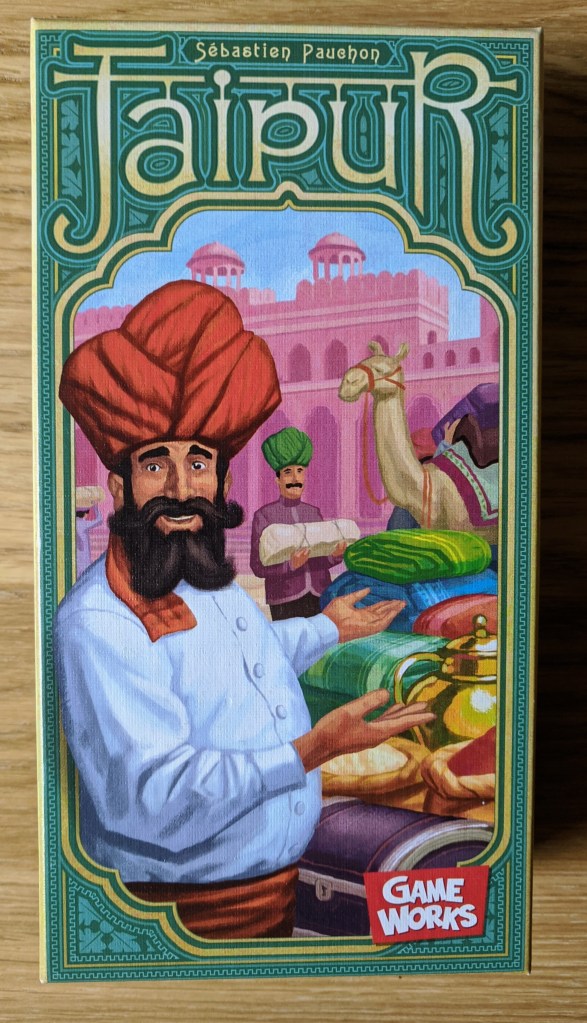
2 players and 25 mins.
Welcome to the city of Jaipur! You enter one of the Pink City’s bustling markets and begin to explore. The true object of your search lies amongst the bright colours, fragrant spices and precious gems– the chance to cut a deal, collect the most rupees and become the Maharaja’s personal trader.
How do you win?
Sell goods to claim rupee tokens; the player with the most rupees at the end of a round wins a Seal of Excellence token. Collect two of these tokens, and you win the game.
How do you play?
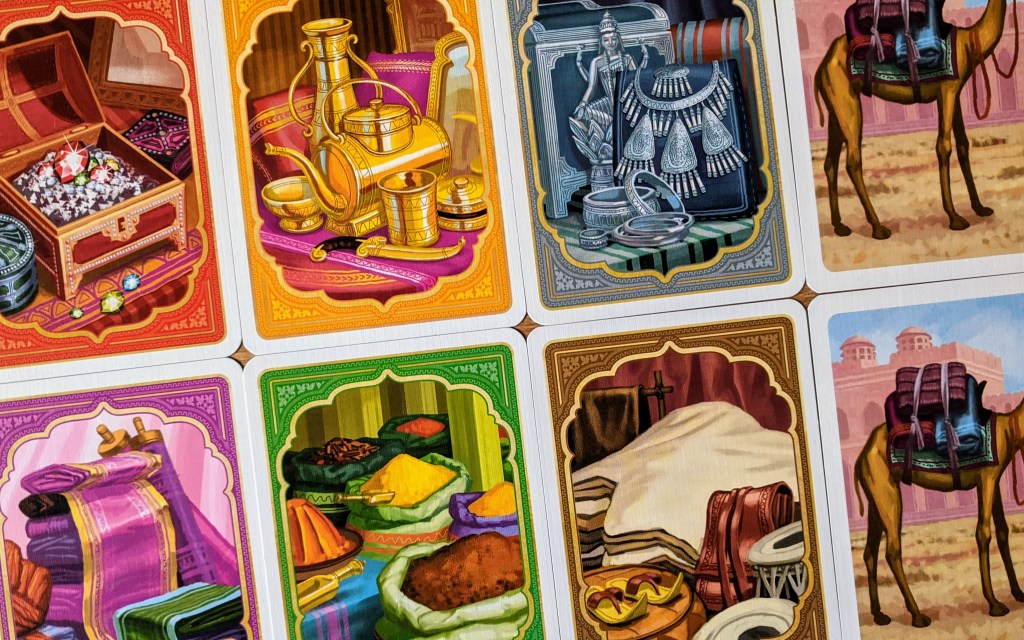
The deck includes two kinds of card: camel cards and coloured cards representing six different goods to trade at the market, namely leather (brown), spice (green) and cloth (purple), and then the more valuable silver, gold and diamonds. Camel cards are a little different to the goods cards; rather than being kept in your hand, they are placed in a pile in front of you as your herd. Conveniently, they do not count towards your seven-card hand limit, but can still be used to buy goods throughout the game – and the player with the biggest herd at the end of the round is awarded a five-rupee bonus.
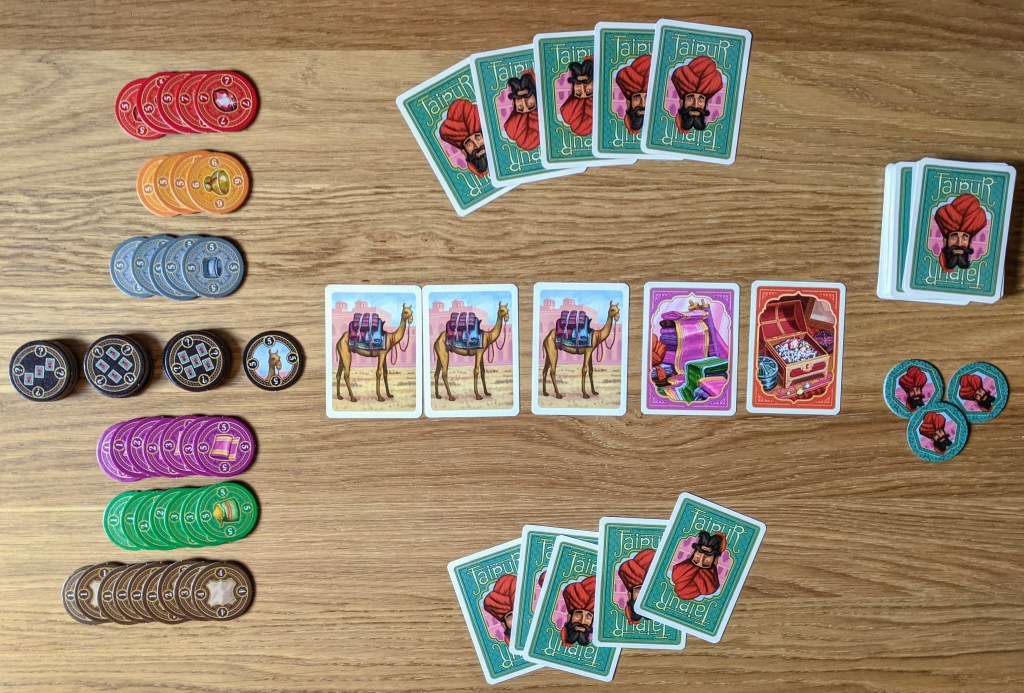
A ‘marketplace’ is set up between the two players, with five cards always on display. To the left of the marketplace are the rupee tokens that can be claimed by selling your wares. Some rupee tokens are more valuable than others, even if they are the same colour – these are always at the top of the pile, available to the early-bird seller.
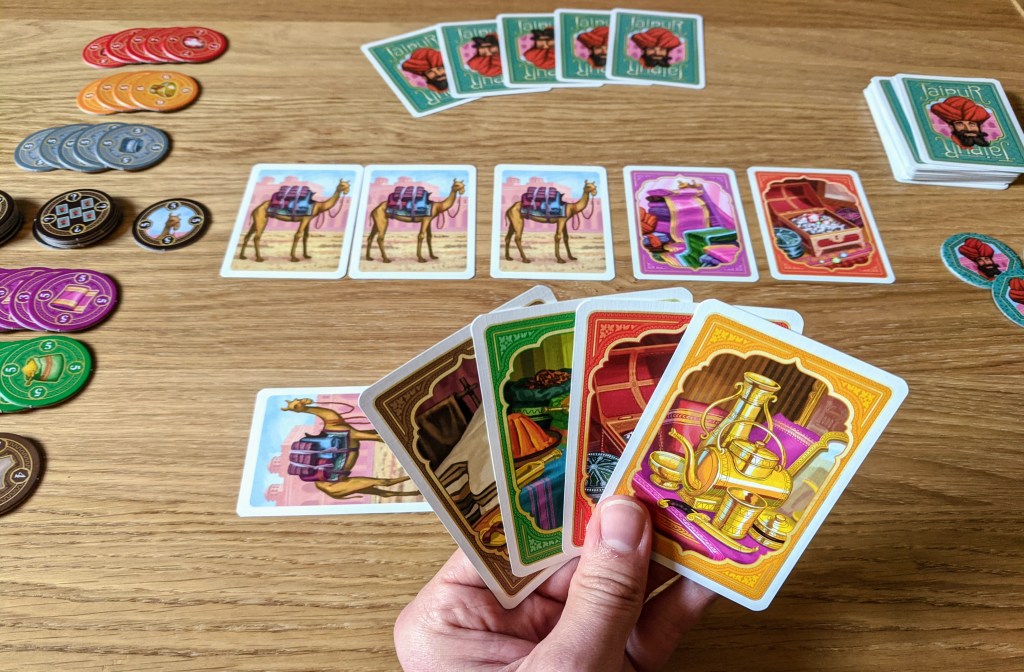
When it is your turn, you may either take cards or sell goods.
Taking involves either:
- exchanging cards (camels from your herd or goods from your hand) for an equal number of goods cards on display at the marketplace in the middle;
- taking one card on display at the market;
- or taking all the camel cards from the market and adding them to your herd.
Selling means discarding at least one goods card from your hand in exchange for the equivalent number of rupee tokens. You can only sell one type of product on your turn, but you can sell as many of that product as you like. If you sell three or more cards in one go, then you also collect the appropriate bonus token; the more goods cards you sell at once, the higher the bonus. Note that when selling the most valuable items (silver, gold or diamonds) you must sell a minimum of two cards.
Play alternates between each player, with each either taking or selling cards. The round will end as soon as three types of goods tokens are sold out or there are no cards left to draw for the marketplace, and players then score up all their rupee tokens.
Why play it?
This game is absolutely excellent in that it is as engaging as other games designed for more than two players. With such a large choice of actions and tactics, the game feels much more open-ended than the traditional battle of logic or luck in other two-player games.
There are several ways to score big points, such as focusing on valuable goods, collecting bonus tokens or being the first to trade. On this last point, our advice would be: sell fast! There is a lot to be said for selling early to grab the high-priced tokens, so keep an eye on which goods your opponent is collecting and try to beat them to the first few most valuable tokens. You’ll gain some quick points (and maybe cause some annoyance!), while denying your opponent the highest-scoring rupees.
Although bonus cards can also lead to rupee riches, be mindful that if you hold out for the larger sale bonus of four or five cards, this can cause you to miss a quick sale (and thus cost you the valuable first sale tokens), while also clogging up your hand, which is governed by the seven-card limit.
The game is nicely balanced, so if your opponent liberates the marketplace of a valuable card you desperately wanted, you will at least get first choice on the new item dealt to the marketplace, which, if luck is on your side, could be that diamond card you’ve been waiting for. Similarly, taking a large herd of camels from the market effectively refreshes the marketplace for your opponent, giving them a large choice of new goods, yet your new large herd gives you a lot of flexibility throughout the game.
Verdict?
Probably our favourite two-player game yet. A lively and fun trading game where you occasionally feel like you are collaborating with your opponent, until it becomes apparent that you are after the same goods! We sometimes play just one round for a quick 10-minute game, but then usually end up playing best of three!
 Cards on the Table