
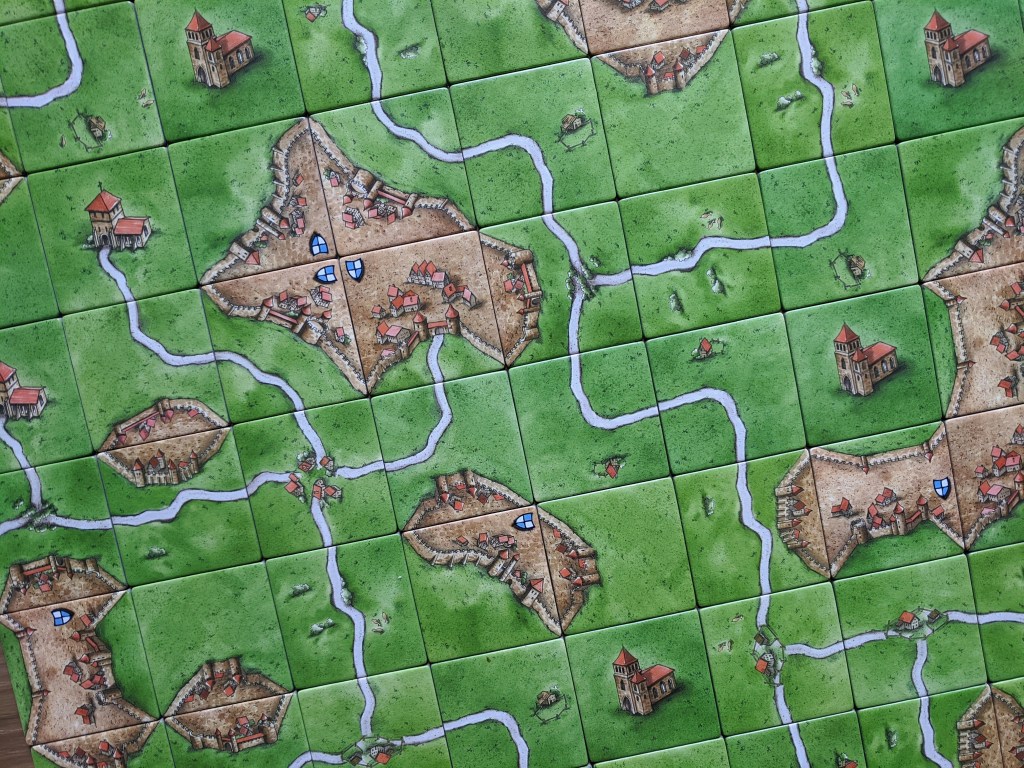
2–5 players and 40 mins.
Come and explore the southern French city of Carcassonne, where a charming map of a medieval world is revealed with each tile laid.
How do you win?
Claim land, roads, castles or monasteries by placing your followers on the newly laid tiles to collect the most points by the end of the game.
How do you play?
Each player collects 8 followers of their chosen colour, placing one of them on the scoring track. Place the special starting tile face-up at the centre of the table and shuffle the rest of the tiles into a facedown stack.
On a player’s turn, they take a tile from the stack and connect it to an existing feature on the map. Each tile will contain some combination of the four features – road, city, green fields or a monastery – and when placed, the tile must not clash with any adjacent tiles; a road on one tile cannot suddenly turn into a field on an adjacent tile, for example. Once a player has placed a tile, they may then decide whether they would like to place a follower on an unclaimed feature of that tile in order to claim points.
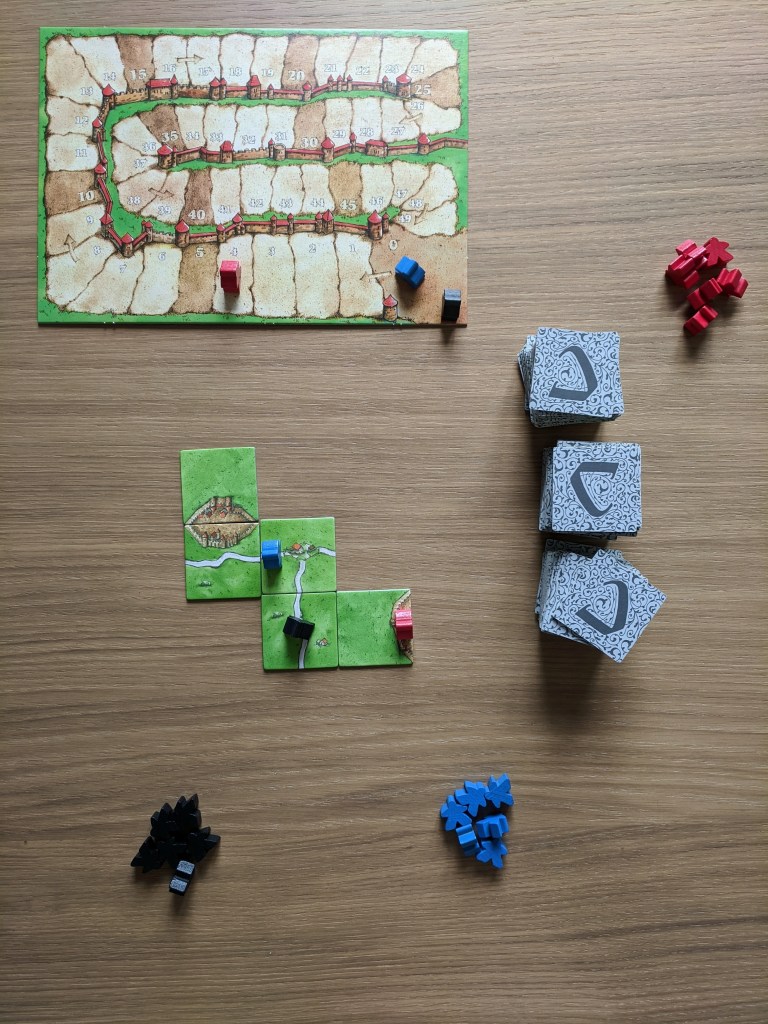
A road is worth 1 point for each tile it runs across, an uncompleted city (where the walls do not enclose the city) is also worth 1 point per tile and a completed city is worth 2 points per tile. A monastery is worth 1 point and an additional point per tile that surrounds it (up to 9 when complete). Your follower will return to your hand for reuse once any of these features are completed.
Farms are the last type of feature and involve a longer game plan. You place a follower on an unclaimed green field and score 3 points per completed city that the field connects to at the end of the game. This can be a gamble as it leaves you with one less follower to play for the remainder of the game but may yield a large bounty of points to add to your score when the game is complete.
Once a player has placed a tile and decided whether or not to place a follower, then their turn is over and play moves clockwise. Play continues until all tiles have been placed and the whole map is revealed.
Why play it?
Although the rules are simple, competition can be intense. Players may scupper your plans for a large city of your own with one strategically placed tile, or place the exact tile you had been waiting for in the middle of nowhere! The clever tile mechanic also means a new layout is created every time you play. As each neatly illustrated tile is placed, it reveals a small medieval world that you could imagine yourself exploring.

There is a tense moment each time you reveal the next tile to lay, hoping that you will pick the perfect square to complete your city – only for you to reveal yet another piece of road! Perhaps next time…
You will attempt to convince others to lay tiles at locations that benefit you, perhaps to complete a city or fill up land adjacent to one of your monasteries, but an opponent usually only helps if there is something in it for them.
Sometimes cities or farms can grow so large that two separate areas merge, meaning that two players have a follower laying claim to the same area. Should this be the case when scored, then both players would claim the points. However, you will want to watch out for opponents trying to overwhelm you in a city or farm by strategically placing a larger number of their followers on new tiles, which they will then attempt to connect to an existing area in order to exclude you and claim all the points for themselves! This is especially true for large farms, which can snake around most of the map by the end of the game, yielding a large number of points to whomever controls them.
Verdict?
Carcassonne is a cheerful yet competitive little game that works well with any number of players – even two! The rules are simple and building up the map is very pleasing.
 Cards on the Table